

Rotational Moulding Machine Company: Essential Questions to Ask Before Choosing a Supplier
2026-11-02
Choosing a rotational moulding machine supplier isn’t just about comparing prices or delivery times. Many buyers overlook critical questions that can lead to costly mistakes later. Before you sign any agreement, consider what you really need to know about the manufacturer’s capabilities, after-sales support, and machine customization options. Rising Sun, a name trusted in the industry, often highlights these overlooked factors. In this post, we’ll walk through the essential questions you should ask to avoid regrets and ensure a smooth production start.
Does the builder have rotomoulding operators on staff or just sales engineers?
Plenty of rotomoulding equipment suppliers build their team around sales engineers. These folks can talk through specifications, cycle times, and pricing, but many have never loaded a mould or dealt with a warped part at 3 a.m. That gap shows up quickly once the machine is installed and the real learning curve begins.
A builder with operators on staff approaches problems differently. They often run new moulds on their own floor before shipping, and their documentation includes notes that only come from hands-on experience—venting quirks, powder flow issues, or how ambient temperature shifts affect wall thickness. It is less about having someone to answer the phone and more about having someone who already knows what the call will be about.
If the team is mostly sales engineers, you might still get a solid machine, but expect to lean on outside consultants or trial and error when a part is not filling correctly. Asking who actually runs the rotomoulding process during development can save a lot of frustration later, especially when you are moving beyond simple tanks and bins into more demanding geometries.
What's the actual heating and cooling time for your thickest part?
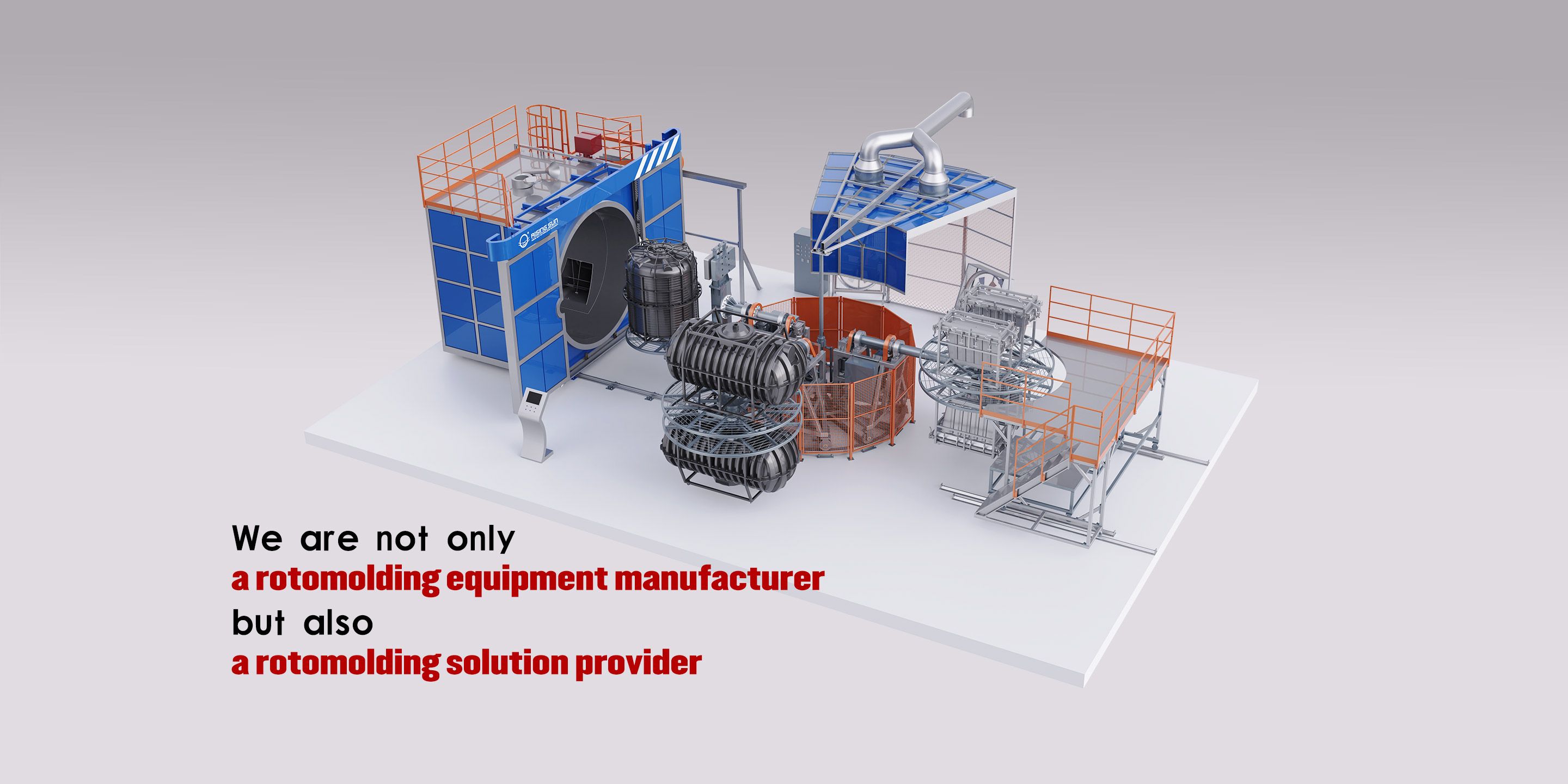
The actual heating and cooling time for the thickest section never matches the nominal cycle you see in a datasheet. Heat has to travel through the entire cross-section, and the center of a thick part lags far behind the surface temperature. In a typical 50 mm steel plate, the core can take 40–60 minutes to reach 80% of the target temperature in a convection oven, while the surface hits the setpoint within 10 minutes. Cooling is even more uneven—still air might drop the surface quickly, but the core can stay hot for hours.
That lag is driven by thermal diffusivity, not just part thickness. A stainless steel block of the same size as an aluminum one will need roughly three to four times longer to reach thermal equilibrium because heat moves through it much more slowly. If you’re relying on a timer instead of a probe, you’re guessing. The only reliable way to know the true heating and cooling time for your thickest section is to bury a thermocouple at its geometric center and log the temperature curve. Anything else is just an estimate based on someone else’s part.
Will they test-run your mould before you pay the final installment?
A reputable mould maker won't expect you to hand over the final payment until the mould has been put through its paces. Test running isn't just about flipping a switch and seeing plastic come out; it's about verifying cycle time, part weight, dimensional stability, and surface finish under real production conditions. If a supplier seems eager to close the deal without showing you a live trial, that's a red flag — not necessarily a scam, but often a sign they're uncertain about their own work or simply don't want to spend the extra hours fine-tuning the tool.
Before you wire that last chunk of money, ask for a trial report with actual moulded samples, not just a verbal guarantee. Better yet, attend the trial yourself or have a trusted agent on site. Watch how the supplier handles issues like short shots, flash, or sink marks. Do they stop and adjust the mould, or do they rush to pack everything up once the first few parts pop out? The difference between a team that treats test running as a final quality gate and one that treats it as a formality will show up quickly when the mould lands in your factory.
Some buyers get nervous about demanding a test run because they fear it will delay delivery or sour the relationship. But any supplier worth their salt already includes trial time in their schedule and price. If they push back, you have to wonder what they're hiding. A properly tested mould might still need minor tweaks after arrival, but you shouldn't be the one discovering warped parts or leaky cooling channels on your production floor. Insist on seeing the mould run before the final installment clears — it's the cheapest insurance you'll ever buy.
How quickly can they get a replacement gearbox to your site?
The answer depends less on the supplier's promises and more on where the gearbox is sitting right now. If a matching unit is already in regional stock, it often goes out the same day and reaches most sites within 24 to 48 hours. For less common ratios or older machine models, the wait stretches because the part has to be pulled from a central warehouse or sourced from a partner depot.
Urgent breakdowns change the calculation. Many suppliers can put a gearbox on a dedicated courier or even a same-day van run, which cuts delivery to a matter of hours rather than days. That speed usually costs extra, but it beats losing a full shift of production. If the site is remote or access is restricted, build in a buffer even when the supplier quotes a fast dispatch.
Before you commit, ask for a live stock check and a confirmed collection time, not just a generic "in stock" label. A gearbox that is available on screen but sitting in another country can add two or three days to the timeline. Clear communication about the exact failure model and any modification plates also prevents the wrong unit arriving quickly, which isn't fast at all.
Can their control system store recipes for different resins and mould weights?
Yes, the control system supports recipe storage for a wide range of resin types and mould weights. Operators can save complete parameter sets—including injection speed, holding pressure, barrel temperatures, and shot size—under unique recipe names. This eliminates manual re-entry and reduces setup errors when switching between materials like polypropylene, ABS, or glass-filled nylon.
Each recipe can be linked to specific mould weight settings, allowing the system to automatically adjust clamp force and metering stroke for different part masses. For example, a 50-gram PP part and a 200-gram PA66 part can each have their own stored recipe, and the controller will load the correct values with a single tap. Recipe storage capacity typically exceeds 100 entries, with USB or network export for backup.
Beyond simple storage, the system logs the actual process values from each production run. This means if a recipe is recalled later, operators can compare current machine behavior against the saved baseline. Such traceability helps maintain consistent part quality across batches, even when different operators or shifts are involved.
What's the real energy draw per cycle on a fully loaded arm?
The sticker on the cabinet rarely tells the whole story. A fully loaded arm pulling nameplate current during a fast pick-and-place cycle burns far more than the average wattage suggests, because acceleration spikes, braking energy, and servo overhead all stack up. On a typical 20 kg payload six-axis unit, a single 1.2-second move can pull 1,800-2,400 W at the peak, but the actual energy per cycle ends up closer to 0.6-0.9 Wh once you integrate the full trapezoidal velocity profile.
Regeneration muddies the number further. When the arm decelerates, the drives push current back onto the DC bus, and unless that energy is shunted or shared with other axes, it gets burned off as heat. So a "fully loaded" spec might say 2 kW, but the wall-meter reading for a continuous 30-cycle-per-minute task often lands between 1.1 and 1.5 kWh per hour, not 2 kWh. That gap is where cheap cycle-time estimates go wrong.
If you want the real per-cycle figure, log DC bus voltage and current at the servo amplifier, not at the AC input. Multiply, integrate over one complete move-and-settle window, then divide by cycle count. You'll usually find the true draw is 25-40% lower than peak power times cycle time, because the arm isn't at full torque for more than a few hundred milliseconds per move.
FAQ
Request a thermal mapping report from a recent machine with a similar diameter. Don't settle for theoretical calculations. You want actual data points collected at multiple locations while the arm rotates under load, not just an empty chamber test. This shows if the burner layout and airflow design can prevent the hot spots that cause warpage on large tanks.
Ask for a utility bill or logged data from a customer running a comparable product. The quoted burner rating doesn't tell you much. A well-insulated oven with efficient gas train can be 20-30% cheaper to run, but you only see that in real usage, not in a brochure. Ask about the turret indexing time and how much heat escapes between cycles.
Any serious supplier should welcome this. A trial exposes how the machine handles your actual wall thickness, drop-arm clearance, and venting. Pay attention to whether the operator adjusts the recipe for your material or just runs a default program. The behaviour during that trial tells you more than ten sales meetings.
Don't rely on the nominal platen size. The swinging radius matters because a mould that fits between the arms might still hit the floor or the oven walls when the arm rocks. Ask for the deflection data at maximum load over a 10-year simulated duty cycle. If the sales engineer hesitates, walk away.
Get a written response about stock levels for gearbox, burner components, and PLC modules. A good supplier has local spare parts or at least a bonded warehouse near your region. Also ask if remote access is via a secure VPN and whether they can push software updates without a site visit. The warranty length means less than a 48-hour parts promise they actually honour.
You need a machine that meets CE or equivalent local standards, but don't stop there. Ask for the safety-rated PLC category and whether the burner management system is separate from the main controller. A flame failure on one burner should not shut down the entire production cycle if the design is robust. Ask for a risk assessment report from a previous installation.
The clamping method matters. Bolted connections are slow, but some quick-release systems apply uneven pressure that distorts the mould over time. Ask for the clamping force distribution across the platen and whether the supplier has tested it with thin-walled aluminium moulds. A good answer includes photos or videos from a real changeover, not a CAD animation.
Training should cover not just button-pressing but also troubleshooting gas pressure switches, servo faults, and recipe optimisation for different polyethylene grades. Ask if the supplier offers on-site training for at least three days plus a refresher after the first month. The best companies also give you access to a hotline answered by an engineer, not a call centre.
Conclusion
Choosing a rotational moulding machine supplier involves much more than flipping through a brochure or comparing quoted prices. One of the first things to pin down is whether the builder has experienced rotomoulding operators on staff, not just sales engineers who know the equipment on paper. That hands-on background shapes how they answer tougher questions, like what the actual heating and cooling time will be for your thickest part, not a theoretical best case. It also tells you whether they will test-run your mould before you pay the final installment, which is a basic safeguard against ending up with a machine that cannot produce your product to spec. A company that runs its own machines can speak honestly about real energy draw per cycle on a fully loaded arm, because they have measured it in their own facility rather than pulling a number from a datasheet.
After the sale, service speed becomes the difference between a minor hiccup and a stopped production line. Ask directly how quickly they can get a replacement gearbox to your site, and pay attention to whether they give a concrete timeframe or a vague promise. You should also check whether their control system can store recipes for different resins and mould weights, since switching between jobs without reprogramming every parameter saves hours and reduces operator mistakes. These are not trick questions. They simply reveal whether a supplier understands day-to-day rotational moulding, and whether they will stand behind the machine once it is installed. If they hesitate on the test-run or cannot explain the energy draw per cycle, that tells you more than any sales presentation.
Contact Us
Contact Person: Sharon Zhu
Email: [email protected]
Tel/WhatsApp: 8615712666272
Website: https://www.risingsunroto.com