
Robotic Bending Factory Redefines Precision Metal Fabrication
2026-10-29
Precision metal fabrication has always demanded exacting standards, but what if the next leap isn't a better tool—it's a smarter process? HUNSONE is answering that question with its robotic bending factory, where automated intelligence meets relentless accuracy. The result? Tolerances measured in microns and turnaround times that once seemed impossible. Yet, the real story isn't just about machines—it's about redefining what's achievable in metal forming. Here's why that shift matters for every fabricator chasing tighter specs.
Inside the Robot Cell That Never Misses a Bend
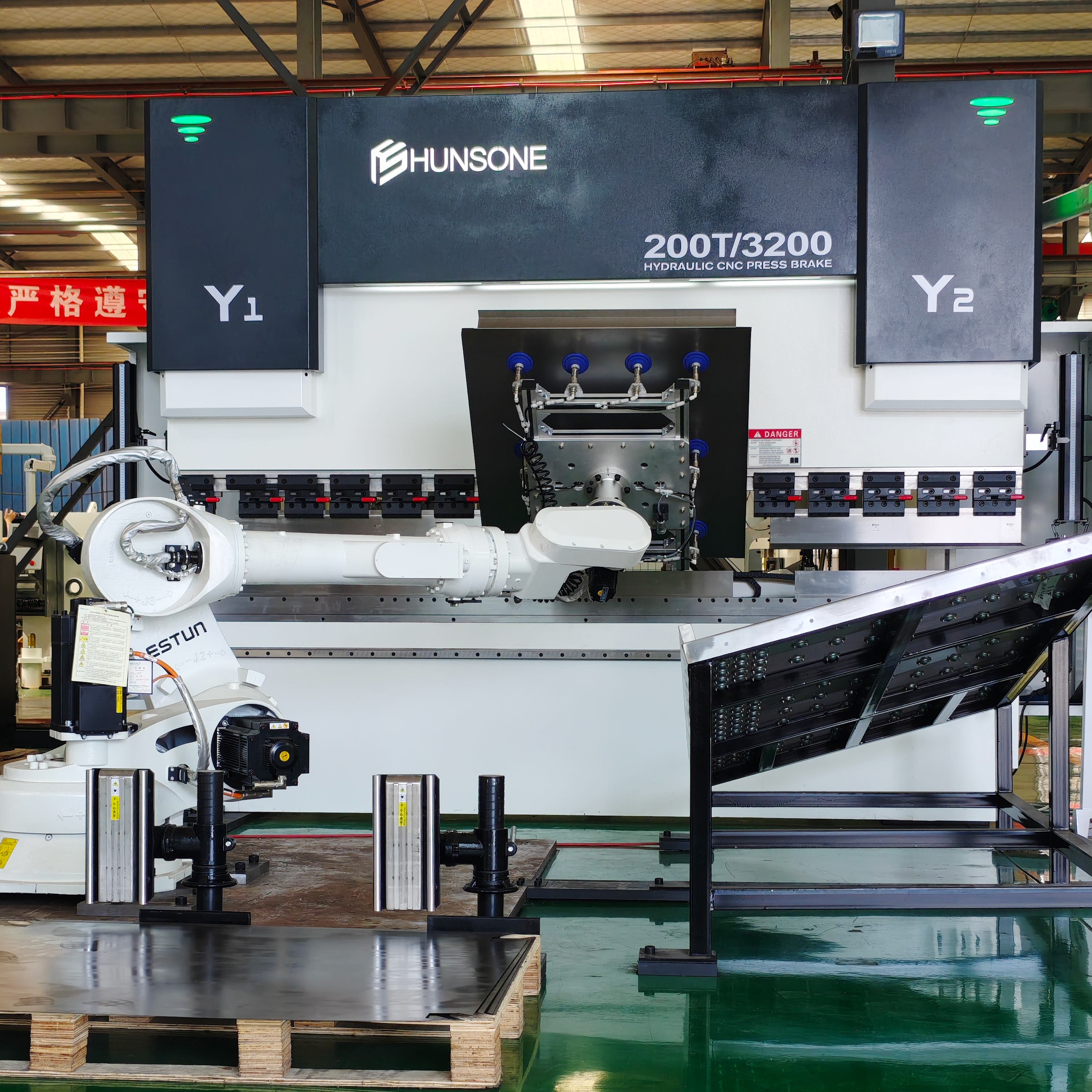
Walk past the guarding and the first thing you notice is how little backlog accumulates at the staging racks. The bender doesn’t wait for an operator to sort blanks, and it doesn’t slow down for awkward profiles. A camera mounted above the infeed checks each piece against the programmed shape before the robot ever touches it, so a misfed part gets kicked to the side conveyor instead of becoming a jammed die.
Inside the cell, the robot changes its grip based on the part family rather than forcing one set of fingers to do everything. On tighter bends, it switches to a narrower jaw and re-gauges from a fixed pin, which keeps the flange location consistent even when material thickness drifts a few tenths. That’s the difference between a cell that mostly bends and one that hits dimension on the first pull.
What really stops the miss isn’t the robot alone. The controller tracks bend angle in real time through the press brake’s own sensors, then trims the next move if springback starts creeping past the tolerance band. You can hear the correction happen—two short taps, a pause, then the final form. It looks almost hesitant, but that pause is the cell deciding not to make a bad part.
Why Springback Is No Longer a Guessing Game
For years, predicting springback in sheet metal forming felt like reading tea leaves. You'd run a simulation, adjust the die, then cross your fingers and hope the part came back within tolerance. The problem wasn't a lack of data, but a mismatch between how materials behave in reality and how traditional models assumed they behaved. That gap turned every new part into an expensive trial-and-error loop.
What changed is the shift from simple kinematic hardening rules to full-cycle material characterization. Modern approaches now capture the Bauschinger effect, transient softening, and even the influence of prior strain paths. Instead of relying on a single tensile test, engineers feed data from cyclic, tension-compression, and bending-under-tension tests directly into advanced constitutive models. The result is a prediction that accounts for how the sheet actually fights back, not just how it stretches.
The real breakthrough, though, is the feedback loop between simulation and production. With machine calibration tied to real-time stamping data, springback correction no longer happens in a design office weeks before tooling is cut. It's iterated on the press line, with each cycle tightening the band. What used to be a guessing game is now a controlled variable, and that changes the economics of every deep-drawn panel.
From Hours of Setup to Minutes of Precision
Remember when calibrating a single instrument meant wrestling with cables, deciphering cryptic menus, and hoping the readings made sense? Those marathon setup sessions weren't just tedious—they quietly ate into budgets, delayed deliverables, and left even seasoned technicians second-guessing themselves. The shift away from that grind didn't come from a single breakthrough, but from rethinking how tools should behave: what if the machine adapted to you, instead of the other way around?
That's the quiet revolution hidden in today's precision workflows. A task that once demanded a full afternoon of troubleshooting now unfolds in the time it takes to pour a coffee. You snap in the sensor, the system recognizes it, and the alignment routine runs itself—checking optics, locking baselines, and rejecting drift before you've even glanced at the screen. No more cross-referencing manuals or repeating the same failed sequence. The margin for human error shrinks, not because people try harder, but because the setup no longer gives mistakes a place to hide.
What gets lost in spec sheets is how that speed changes the rhythm of the workday. When precision arrives in minutes rather than hours, you stop hoarding setup time as a scarce resource. You run the extra verification scan. You test the alternate angle. You catch a subtle misalignment that would have gone unnoticed last year. Precision stops being a destination you crawl toward and becomes a place you simply arrive—again and again, without ceremony, until the remarkable thing isn't the result, but how unremarkable the effort behind it has become.
The Self-Sensing Brake That Adjusts on the Fly
Most brakes work on a simple principle: apply force, create friction, and hope the result matches what the driver expects. This self-sensing brake takes a different path. Tiny sensors embedded in the brake pad continuously monitor heat, pad wear, and rotor surface condition. Instead of relying on preset assumptions, the system reads these signals in real time and adjusts clamping pressure millisecond by millisecond. That means the brake doesn't just react to the pedal—it responds to the actual state of the friction pair. On a long descent, the pad material softens slightly, and the brake backs off just enough to avoid glazing. On a wet morning, it adds a light initial squeeze to clear water film before full engagement.
The real advantage shows up in inconsistent conditions. Traditional brakes are tuned for a narrow window: cold bite, mid-temperature friction, and fade resistance are all compromises stacked on a single curve. Here, the control loop shifts its own calibration as the hardware changes. A pad that has worn from 12 mm to 7 mm doesn't behave like a new pad, so the brake stops pretending it does. The software adjusts the hydraulic or electric actuator's gain to maintain a consistent pedal feel and stopping distance. Fleet operators notice fewer sudden pad replacements because the system spreads wear more evenly across the friction surface.
What makes this approach feel less like a gimmick is that it borrows from industrial motor control rather than automotive marketing. Variable frequency drives have used self-sensing rotor position for decades without hall sensors. Applying that same observer-based logic to a brake caliper means the system doesn't need an external dynamometer to know what's happening at the contact patch. It infers slip, temperature gradient, and even brake fluid viscosity from the actuator's own current and voltage signatures. The result is a brake that quietly adapts its personality—firmer when the rotors are cold, slightly softer when they're heat-soaked—without the driver ever touching a settings menu.
Small Batches, Zero Scrap: The New Economics
Traditional mass production treats volume as the only path to lower unit costs. Yet that logic quietly buries cash in bloated inventory, warehouse fees, and eventual markdowns for styles nobody wanted. Running smaller batches flips the equation: you make what sells, keep cash moving, and stop paying to store mistakes. The result is a supply chain that can shift product mix within weeks instead of being locked into a twelve-month forecast.
Zero scrap is less about being green and more about protecting margin. Digital sampling, precision cutting, and on-demand material planning routinely push yield rates above 90%, eliminating the trimming waste, overruns, and unsold stock destruction that plague long production runs. Every skipped scrap bin is money that stays in the P&L, and the brand gets a cleaner story without having to exaggerate.
The new economics really come down to turnover and working capital. Smaller batches shorten the cash conversion cycle, reduce discounting pressure, and allow premium pricing for limited or custom runs. For a mid-sized manufacturer, that means testing a new line no longer requires betting the company on a single huge order. When waste approaches zero and production matches demand, being small and precise beats being big and cheap.
How Sensor Fusion Redefines 'Straight and True'
In the early days of autonomous navigation, a single sensor often had the final say. GPS could report a clean, straight line across a map, yet the vehicle might be drifting subtly across lane markings or fighting a crosswind. Inertial measurement units tracked heading with precision but accumulated drift over time, slowly bending the notion of 'straight' into a gentle curve. Camera-based lane detection worked beautifully on clear days but faltered in rain, snow, or when the sun glared directly into the lens. 'Straight and true' was less a physical reality and more a fragile promise held together by whichever sensor happened to be behaving at that moment.
Sensor fusion changes the conversation by refusing to trust any single voice. Instead of asking 'Which sensor is right?', the system asks 'What combination of measurements best explains the world right now?' A Kalman filter or a factor graph takes the raw streams from GPS, IMU, cameras, radar, and lidar, then weighs each based on its current confidence. When GPS signal quality degrades near tall buildings, the IMU and visual odometry step forward to keep the path straight. When the camera loses contrast on a dusty road, radar and lidar maintain the true edge of the lane. The result is not an average of conflicting opinions but a continuously re-negotiated consensus that holds the vehicle to a line far straighter than any single sensor could guarantee.
This redefinition of 'straight and true' also means acknowledging that the truth is dynamic. A straight line on a hill is not the same as a straight line on a flat highway; pitch, roll, and road crown all influence what 'true' means at any instant. Sensor fusion models these variables explicitly, so the vehicle's path bends only where the road genuinely bends, not because a gyroscope drifted or a GPS satellite dipped below the horizon. In practice, engineers see the difference as a matter of centimeters at highway speeds, yet those centimeters are what separate a confident hands-free drive from a constant, subtle correction. By fusing measurements rather than trusting them individually, the system turns a poetic ideal into a measurable, repeatable behavior.
FAQ
Robots use closed-loop feedback from sensors and laser measurement to adjust bend angles in real time, eliminating variations caused by operator fatigue or material springback.
Complex sheet metal parts for enclosures, brackets, chassis, and structural frames, often with multiple bends and tight tolerances.
Yes, modern robotic cells with automatic tool changers and offline programming can switch between part designs quickly, making low-volume runs cost-effective.
Software simulates bending sequences, predicts springback, and generates collision-free robot paths, reducing setup time and scrap.
It shifts operators from repetitive manual bending to supervising multiple cells, programming, and quality control, which raises skill requirements but improves safety.
Consistent repeatability, higher throughput, fewer errors, and the ability to run lights-out production without constant human attention.
With the right robot payload and press brake tonnage, these systems can bend thick steel and high-strength alloys, though process parameters need careful tuning.
By simulating bends and automatically compensating for material properties, it avoids trial-and-error setups and reduces the number of scrapped parts.
Conclusion
Modern robotic bending cells have turned precision metal fabrication from an art of accumulated guesswork into a repeatable, data-driven process. Instead of relying on operator intuition for every bend, the robot cell continuously tracks material behavior and tool position, so the first part comes out as accurately as the hundredth. Springback—the tendency of metal to relax after bending—used to demand trial bends and manual compensation, but now it is measured and corrected in real time, eliminating the old back-and-forth between press brake and inspection table. Setup that once consumed hours with iterative adjustments now takes minutes, because the cell automatically aligns tooling and verifies bend angles before production begins. This shift doesn’t just speed things up; it removes variability that quietly ate into margins.
At the heart of this reliability is a self-sensing brake that adjusts parameters on the fly, compensating for material variation, temperature drift, and tool wear without stopping the line. Paired with sensor fusion across angle measurement, force feedback, and part positioning, the system keeps every flange straight and true even in mixed-model runs. That capability changes the economics of small batches: where short runs once meant high scrap rates and conservative tolerances, today they run with zero scrap and full repeatability. Manufacturers no longer have to choose between flexibility and precision—the robotic cell delivers both, making high-mix, low-volume production as cost-effective as mass production. The result is a factory floor where bending is no longer a bottleneck but a benchmark for accuracy.
Contact Us
Contact Person: James Chen
Email: [email protected]
Tel/WhatsApp: 86 13770803946
Website: https://www.hunsone.com/