

MCM Flexible Stone for Interior Walls: A Powerful Manufacturer's Guide to Modern Design
2026-08-27
When interior walls become canvases for texture and movement, rigid materials often fall short. MCM flexible stone is changing that—and Magic Stone sits at the center of this shift. This guide cuts through the noise to show you how a manufacturer's expertise can transform modern interiors with lightweight, bendable stone surfaces that are as practical as they are striking. From design freedom to installation wins, here's what actually matters before you specify your next wall finish.
What Actually Makes MCM Flexible Stone Different From Rigid Wall Panels
Rigid wall panels lock you into flat, unforgiving surfaces. MCM flexible stone bends and curves with the architecture, wrapping around columns, arches, and irregular shapes without cracking or snapping. That pliability isn't just a novelty — it means fewer joints, fewer cuts, and a finished look that feels continuous rather than pieced together from hard tiles.
Weight plays a bigger role than most people realize. Traditional stone or ceramic panels demand heavy-duty substrates, extra labor, and often structural reinforcement. MCM flexible stone weighs a fraction of those materials, so you can install it over existing drywall, plywood, or even lightly textured surfaces. No special backing board, no sagging, no need to beef up the framing just to hold the wall covering.
And then there's the feel of it. Rigid panels transmit impact — a bump from furniture or a stray elbow leaves a mark, a chip, or a hairline crack. MCM flexible stone has a slight give, absorbing everyday knocks without damage. It also resists thermal expansion issues that plague rigid materials outdoors, staying put through temperature swings without buckling at the seams.
Reading a Sample: How to Judge Flexible Stone Quality Before You Buy
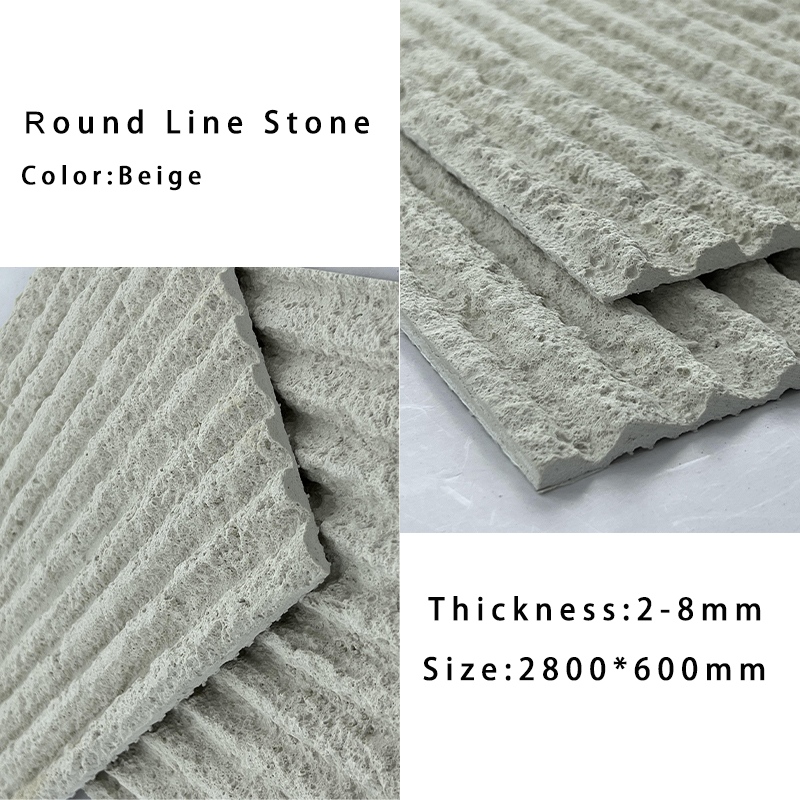
Grab a sample and start with the surface. A good flexible stone should show natural stone texture without powdering or flaking when you rub your fingers across it. If your hand picks up visible stone dust, the binder content is likely too low. Also check the edges for clean cuts and any sign of delamination between the stone layer and backing.
Next, do a simple bend test. Slowly flex the sample to about 90 degrees or a bit more, then watch closely. Cheap material will crack, snap, or separate from the backing almost immediately. Quality flexible stone should handle this without major cracks, and it should mostly return to flat when you let go.
Finally, flip it over and check the backing for even coating, bubbles, or sticky spots. Give it a sniff too; a sharp chemical smell often means low-grade resin that can cause problems later. Compare several pieces from the same batch under the same light to spot color or texture drift before placing a full order.
Five Interior Wall Layouts Where Flexible Stone Outperforms Paint and Tile
When you're dealing with curved accent walls, paint and tile quickly show their limits. Paint can't add texture, and rigid tile requires countless cuts to follow a radius. Flexible stone, in contrast, bends around gentle arcs without seams or grout lines, giving you a continuous surface that looks like quarried rock but behaves like thick wallpaper.
In high-moisture zones like a shower surround behind a freestanding tub, traditional tile means endless grout maintenance and eventual staining. Paint peels within a year. Flexible stone sheets, when sealed properly, create a monolithic, water-resistant barrier that shrugs off steam and splashes while keeping the warm, natural look of slate or travertine.
For a fireplace feature wall that wraps from the living room into a reading nook, tile edges chip and paint shows every scuff. Flexible stone handles inside and outside corners as one piece, eliminating the visual clutter of trim pieces. The result is a quiet, tactile backdrop that reads as solid masonry, not a manufactured panel.
Substrate Preparation and Adhesive Tricks From Production Floor Experience
A clean surface sounds obvious, but on the line it's rarely the case. We used to chase adhesion failures until we started wiping every substrate with a lint-free cloth and a fast-evaporating solvent like isopropyl alcohol, then letting it flash off completely. If you skip the flash-off, you're just smearing contaminants around.
Abrasion isn't always needed, but for glossy plastics or powder-coated metals, a quick scuff with 320-grit or a red Scotch-Brite pad can double bond strength. Don't overdo it—too rough a profile creates peaks that starve the adhesive of contact area.
For adhesives, temperature is the trick nobody talks about. Most production floors run cold in the morning, so we keep the adhesive and substrates at 20–25°C for at least an hour before bonding. Cold adhesive wets poorly and thickens, leading to weak bonds that pass initial pull tests but fail after thermal cycling.
The Truth About Flexible Stone Durability in Humid and High-Traffic Rooms
Flexible stone panels aren't just a pretty surface for accent walls. In rooms that see constant moisture, like bathrooms or laundry areas, their open-pore structure actually allows the material to breathe. That means trapped humidity doesn't sit behind the surface the way it can with sealed ceramic or glass tiles. As long as the substrate is properly waterproofed and the flexible stone is sealed with a breathable penetrating sealer, it resists mold and mildew growth surprisingly well. The key is avoiding film-forming coatings that lock in moisture and create a cloudy, peeling mess over time.
High-traffic zones such as entryways, kitchens, and hallways put a different kind of stress on any wall finish. Flexible stone holds up better than you might expect from a material that feels like thick leather. It has a natural resistance to scuffing and minor impacts because the stone veneer is backed by a flexible polymer that absorbs shock instead of cracking. Daily foot traffic, rolling luggage, or even a kicked baseboard won't leave permanent dents. The surface does show wear in the form of slight polishing or darkening in heavy touch points, but that patina actually adds character rather than looking damaged.
One truth that rarely gets mentioned: installation quality matters more than the material itself in humid, busy rooms. If the flexible stone is applied over uneven drywall or with wrong adhesive, moisture can wick behind the panel and cause edge lifting. In bathrooms, always use a cement-based adhesive rated for wet areas and leave a small expansion gap at the floor line. For high-traffic areas, a matte finish sealer is your best friend—it prevents stains from muddy shoes or cooking splatter while keeping the stone's natural texture grippy underfoot. The bottom line? Flexible stone can handle the tough rooms, but only when you treat it as a real building material, not a peel-and-stick poster.
Customization Options Most Manufacturers Won't Tell You About
Most factories won't volunteer the fact that you can often change the internal chassis layout without altering the outer shell. Ask about alternate board positions, cable routing, or even a different power supply placement, and you might unlock a configuration that fits your use case far better than the stock photo suggests. These are not standard menu items, but many production lines can accommodate them if you know to raise the question before tooling starts.
Another quiet lever is packaging and labeling. Beyond the default brown box, some manufacturers will let you run smaller batches with custom inserts, foam cutouts, or dual-language instruction cards for a nominal setup fee. The key is to ask during the quoting stage, not after the first article sample. Once the line is tuned for a particular SKU, changes become expensive and rare.
Materials are another hidden door. A factory may list only two or three finishes on its public catalog, but if you ask about the supplier's raw stock room, you might discover a handful of substrates or coatings that never made it to the website. This often includes low-gloss options, anti-fingerprint treatments, or even recycled-content versions that meet certain compliance needs without a full redesign.
FAQ
MCM flexible stone is a lightweight composite that mimics the texture and look of real stone while remaining pliable enough to bend around curved walls or pillars. Unlike natural stone, it doesn't require heavy structural support, and it comes in large panels that cut down on grout lines. That flexibility opens up designs that rigid stone can't handle, such as wrapping a column seamlessly or cladding a curved feature wall.
Installation is much faster and cleaner. The panels can be cut with a utility knife, applied with a standard adhesive, and pressed onto a primed surface. There's no need for mortar, mesh, or special tools, and most interior walls don't require additional framing. A two-person crew can often finish a feature wall in a single day, whereas natural stone would take significantly longer and create more mess.
Yes, but the substrate needs to be properly waterproofed first. MCM flexible stone itself is resistant to moisture and won't warp or crack from humidity, but the adhesive and sealant joints must be rated for wet environments. For shower walls or steamy bathrooms, use a waterproof membrane behind the panels and seal all edges carefully to prevent water intrusion.
It suits a wide range, but it really shines in modern and organic styles. The continuous, low-contrast surface works well in minimalist interiors, while the natural stone textures add warmth to industrial or Japandi spaces. Designers often use it to create a single accent wall, wrap a fireplace, or line a hallway where natural light can highlight the subtle undulations.
Maintenance is minimal. Dust the surface regularly with a soft cloth or vacuum brush. For deeper cleaning, a mild soap and water solution with a non-abrasive sponge is usually enough. Avoid harsh chemicals or pressure washing, as they can damage the surface coating. Most MCM products have a protective top layer that resists stains, so spills just need to be wiped up promptly.
Absolutely. The material is impact-resistant and holds up well to daily wear. In commercial settings, choose a product with a thicker wear layer and use a high-strength adhesive rated for high traffic. Many manufacturers offer versions that meet fire safety standards for interior cladding, which is a key consideration for public spaces.
The biggest mistake is ignoring the surface preparation. The wall needs to be smooth, clean, and dry; otherwise, the panels may not bond evenly and can telegraph imperfections. Also, avoid using it on floors or countertops since it's designed for vertical surfaces. And while it handles moisture well, it shouldn't be submerged or used as a shower pan liner.
Conclusion
MCM flexible stone is a fundamentally different animal from rigid wall panels, and that difference shows up the moment you handle a sample. Real stone veneer bonded to a polymer base gives it the ability to bend around curves, wrap columns, and follow uneven substrates without cracking the way tile or fiber cement would. When judging a sample before buying, don't just look at the surface—bend it hard, scratch it lightly, and check the backing for that slightly rubbery, resilient feel. A quality product should flex without delaminating, show realistic stone texture rather than a printed-looking pattern, and keep its color stable under different lighting. In practice, flexible stone outperforms paint and tile in at least five interior layouts: accent walls with architectural reveals, curved or arched feature walls, ceilings where weight and adhesion matter, wrapped columns or beams, and kitchen or bathroom backsplashes where grout lines typically trap moisture and fail over time. Paint can't replicate the depth of real stone, and tile brings grout maintenance plus installation headaches on non-flat surfaces.
Substrate preparation is where most installation failures start, so production floor experience says: clean off all dust and grease, skim-coat any rough drywall, and prime porous surfaces with a bonding primer before you even open the adhesive bucket. Use a polyurethane-based adhesive or a high-quality polymer-modified thin-set, apply it with a 3/16-inch V-notch trowel, and press the flexible stone firmly with a roller to eliminate air pockets—don't rely on hand pressure alone. In humid and high-traffic rooms like bathrooms, laundry areas, or commercial corridors, flexible stone holds up surprisingly well because it doesn't absorb water the way natural stone slabs do, and there are no grout joints to harbor mold. That said, you still need to seal exposed edges and use a flexible sealant at inside corners to prevent moisture creep. On the customization side, most manufacturers won't volunteer that you can order thicker stone layers for high-impact zones, wider sheets to reduce seams, custom color blends to match a specific design palette, or even pre-applied adhesive backing that turns installation into a peel-and-stick job. Ask about custom molds if you want a texture that isn't in the standard catalog—many factories can produce it for a reasonable minimum order, but they rarely advertise that capability.
Contact Us
Contact Person: Vito
Email: [email protected]
Tel/WhatsApp: 86 13088879266
Website: https://www.magicstonemcm.com