

Healthcare Wristband Kiosk Terminals: Transforming Patient Identification and Safety
2026-07-01
Imagine a bustling hospital lobby where every second counts. Patient safety hangs in the balance, often tied to a simple wristband that ensures the right care reaches the right person. Yet traditional wristband processes are manual, slow, and prone to error—until now. Enter the era of healthcare wristband kiosk terminals, where on-demand printing meets intelligent verification to slash wait times and eliminate misidentification risks. At the heart of this shift is BAOBI, a name redefining patient identification with self-service precision. This isn’t just about printing a tag; it’s about weaving safety into every interaction, from check-in to discharge. Let’s explore how these terminals are quietly transforming hospitals, one accurate scan at a time.
Rethinking Patient ID: The Role of Self-Service Kiosks in Modern Hospitals
In an era where efficiency defines patient experience, the humble check-in process has become a bottleneck waiting to be dismantled. Self-service kiosks are stepping in not just as gadgets, but as a fundamental rethink of how hospitals handle patient identity. Rather than lining up to repeat personal details to a receptionist, patients can now confirm their identity through biometric scans, QR codes, or simple touchscreen prompts—cutting down the risk of clerical errors while giving individuals a sense of control from the moment they walk in.
Beyond convenience, the shift to kiosk-based identification tackles a deeper issue: the fragility of manual data entry. Misspelled names, swapped birthdates, or outdated insurance details can cascade into clinical mishaps and billing nightmares. Self-service terminals pull directly from integrated electronic health records, allowing patients to review and update their own information before any care is rendered. This real-time validation acts as a quiet safety net, reducing claim denials and enhancing the accuracy of medical histories without adding strain on staff.
Hospitals that have adopted these systems report a subtle but meaningful cultural shift. Front desk staff are freed to handle complex cases, while patients who are able to self-serve often feel more engaged in their care journey. The kiosks become not just a tool for ID verification, but a gateway to appointment scheduling, wayfinding, and even copay collection—turning a once tedious transaction into a seamless, dignified start to a hospital visit.
From Check-In to Care: How Wristband Terminals Streamline Workflows
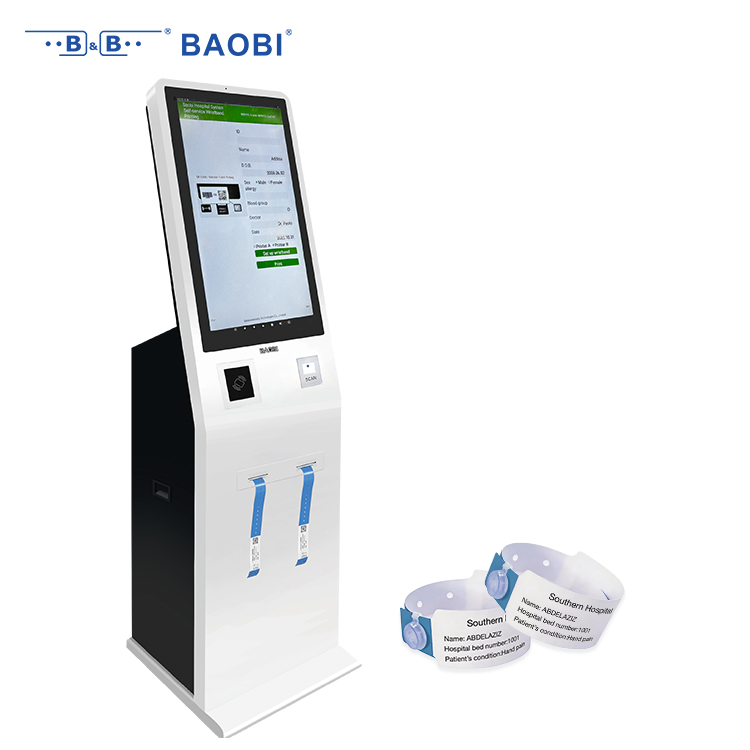
Picture a busy hospital entrance where patients once fumbled with clipboards and paperwork. Now, a simple wristband changes everything. It’s tagged at the moment of arrival, linking identity to a digital thread that moves seamlessly from registration straight into the care pathway. No repeated form-filling, no lost records—just a quick scan that says, ‘This person is ready, and here’s their story so far.’ The whole intake process collapses into a few seconds, letting staff focus on people instead of data entry.
Away from the front desk, the real magic unfolds. That same band accompanies the patient to labs, imaging suites, and the bedside. Nurses pull up medication schedules with a tap; lab techs confirm specimen labels instantly against the wristband ID. Even in chaos—a sudden rush of emergencies—the terminals cut through noise, matching the right care to the right person without hesitation. It’s a quiet sort of orchestration, where the band becomes both a navigator and a safeguard, trimming every unnecessary step that slows down healing.
When discharge finally nears, the workflow doesn’t stumble. Prescriptions, follow-up instructions, and billing all tie back to that initial scan, negating the usual scramble of searching through files. No one’s chasing down a signature from a busy doctor or waiting on a paper trail. The wristband terminal silently closes the loop, turning a fragmented journey into one fluid movement—from hello to recovery, without a single break in the chain.
Safety Beyond the Barcode: Innovations in Error-Proof Identification
Barcodes revolutionized product tracking decades ago, but their limitations are increasingly evident in high-stakes environments. Smudged labels, poor lighting, and damaged prints can lead to misreads—or worse, no read at all. In industries where a single error can halt production lines or compromise patient safety, relying solely on barcodes feels like trusting a fading map in a rapidly changing landscape. The shift toward more resilient identification methods isn’t just a technical upgrade; it’s a necessary evolution to keep pace with the complexity of modern supply chains and critical workflows.
Enter a new generation of verification tools that embed identity directly into materials or use invisible markers to eliminate human guesswork. Radio-frequency identification (RFID) tags, for example, let items announce themselves without requiring line-of-sight scanning, dramatically reducing handling errors. Meanwhile, image recognition systems trained on vast datasets can differentiate between nearly identical components in milliseconds, catching mismatches that even attentive workers might miss. These advances transform identification from a passive check into an active safeguard, silently intervening before mistakes cascade downstream.
Perhaps most striking is how these innovations shift the focus from post-hoc error detection to real-time prevention. Serialization at the unit level, combined with encrypted digital twins, means every item carries a verifiable history that can be validated instantly. In pharmaceutical packaging, this approach thwarts counterfeits and ensures patients receive exactly the right dose from the right batch. It’s safety reimagined—not as a barcode that can be overlooked, but as an intrinsic, error-proof conversation between the physical object and the systems meant to protect us.
Patient Empowerment Through Touchscreen Simplicity
Modern healthcare often overwhelms patients with complex portals and jargon-filled interfaces. By stripping away the unnecessary and focusing on intuitive touchscreen design, we give individuals direct control over their health journey. A simple tap to view test results, schedule appointments, or message a provider turns passive recipients into active participants.
This approach removes common barriers like confusing menus or small text, making digital health tools accessible to all age groups and tech comfort levels. When patients can effortlessly navigate their own records and care plans, they feel more confident asking questions and following through with treatments. The tactile, visual nature of touchscreens reinforces understanding and retention.
Ultimately, the goal is to make health management feel less like a chore and more like a natural extension of daily life. Simple, responsive interfaces encourage regular engagement, leading to better preventive care and stronger patient-provider relationships. Empowerment starts with a screen that works with people, not against them.
Behind the Screen: Integrating Kiosks with Hospital Information Systems
Bringing self-service kiosks into a hospital isn’t just about placing a terminal in the lobby. It’s a careful dance of data exchange, where the kiosk must talk fluently with the hospital’s existing infrastructure—think electronic health records, appointment scheduling modules, and billing gateways. Without a deep integration, the kiosk becomes little more than a fancy digital clipboard, forcing staff to manually bridge the gap between what the patient entered and what the system actually needs.
The real complexity lives in the middleware. Kiosks often rely on HL7 or FHIR standards to pull patient demographics and push check-in updates back into the central system. But every hospital has its own ecosystem of legacy software, custom APIs, and security protocols. That’s why the integration phase rarely follows a straight line. It involves mapping data fields, handling mismatched identifiers, and designing fallback workflows when a patient’s record can’t be found or their insurance eligibility fails to verify in real time.
When done right, the kiosk disappears into the patient experience—it just works. People scan a driver’s license or tap in a confirmation code, and within seconds their appointment is confirmed, copay collected, and the care team notified. This seamless flow depends on a behind-the-scenes architecture that prioritizes both speed and accuracy, often caching frequently accessed data to shave off precious milliseconds. It’s a reminder that the most intuitive front-end is always propped up by a meticulously engineered back-end.
The Ripple Effect: How Instant Wristbands Reduce Wait Times and Anxiety
Long queues at event entrances do more than just eat up time—they slowly erode the excitement that brought people there in the first place. Every minute spent shuffling forward drains energy from the crowd, replacing anticipation with mild frustration. Instant wristbands flip that dynamic. By allowing attendees to verify their access in seconds, the entry process turns into a fluid, almost unnoticed step. The moment of arrival becomes a genuine high point, not a test of patience. This immediate, frictionless entry ripples outward, setting a tone of efficiency that colors the entire experience.
The mental toll of waiting is often underestimated. Uncertainty about how long the line will take, combined with the physical confinement of a queue, can spike cortisol levels and dampen mood before the event even begins. Quick-scan wristbands dismantle this stress by removing the guesswork. People move through checkpoints in a steady, predictable rhythm, free from the awkward fumbling for paper tickets or the anxiety of a slow badge check. That small moment of relief compounds; when individuals feel respected and unburdened at the door, they enter with a more open, receptive mindset. The atmosphere shifts from one of collective endurance to one of shared ease.
But the benefits don't stop at the gate. Staff members, no longer locked in a battle against swelling lines, can redirect their attention to hospitality rather than crowd control. They have the bandwidth to smile, answer questions, and offer genuine assistance—tiny interactions that amplify the sense of welcome. Meanwhile, attendees, having sidestepped the early burnout of a long wait, arrive at sessions, booths, and performances more present and engaged. The ripple continues: fewer bottlenecks mean smoother logistics throughout the venue, from concession stands to restrooms. What starts as a simple wristband quietly reshapes the entire event ecosystem, proving that sometimes the smallest changes trigger the largest shifts in how we feel and connect.
FAQ
They are self-service stations placed in waiting areas that let patients print their own ID wristbands during check-in, which speeds up registration and cuts down on manual data entry mistakes.
By printing wristbands with verified information straight from the patient's records, they eliminate mix-ups that can lead to wrong medications or procedures.
Yes, the touchscreens walk you through a few simple steps, and the interface is designed to be clear even for people who aren’t comfortable with technology.
The terminal flags the mismatch right away and notifies a staff member, so no incorrect wristband gets printed.
They typically integrate directly with electronic health record systems, pulling in the patient’s data instantly to ensure accuracy without extra work.
Absolutely, since patients handle the wristband step themselves, the front-desk line moves much faster.
They use strong encryption and require authorized logins, protecting sensitive information just like other clinical devices.
Conclusion
Healthcare wristband kiosk terminals are quietly reshaping the patient experience, turning what was once a tedious check-in into a seamless, self-directed process. Rather than relying on harried staff to verify identities and print wristbands, patients can now approach a touchscreen, confirm their details, and have a durable, barcode-equipped band issued in seconds. This shift does more than save time—it fundamentally rethinks how hospitals establish patient identity at the very first point of contact. The simple act of generating a wristband on the spot eliminates transcription errors, ensures that every caregiver scans the correct record, and links the patient instantly to their digital chart. Behind the scenes, these kiosks talk directly to hospital information systems, pulling appointment data, insurance details, and even allergy alerts, so the wristband becomes a live, error-proof bridge between the person and their care journey.
The ripple effects extend far beyond the check-in counter. When patients bypass long queues and administrative hurdles, anxiety drops, and satisfaction climbs—people feel more in control when they can manage their own registration with a few screen taps. For staff, workflows become lighter: nurses no longer need to interrupt clinical duties to print bands or double-check handwriting, and the reduced friction means fewer delays in treatment. Safety innovations, like tamper-resistant bands or real-time data validation, add layers of protection against mistakes that even traditional barcodes sometimes miss. These terminals also empower patients to update demographics or consent forms without repeating themselves at every desk. As hospitals look to do more with less, wristband kiosks deliver a quiet but powerful transformation—blending touchscreen simplicity with backend intelligence to make every identification moment safer, faster, and more human-centered.
Contact Us
Contact Person: Bill Xu
Email: [email protected]
Tel/WhatsApp: 8618688898707
Website: https://www.baobitech.com/