

Folding Carton Cutting Die Making Equipment Manufacturer Key Factors to Evaluate
2026-09-02
Selecting the right folding carton cutting die making equipment manufacturer is a decision that can quietly determine your production efficiency, tooling longevity, and bottom line. Many converters focus on machine specs alone, but the real differentiators often hide in engineering depth, material consistency, and after-sales responsiveness. Whether you are upgrading a die shop or building one from scratch, knowing what truly matters before comparing quotes can save costly downtime later. As a global supplier known for precision and robust after-sales support, ADEWO has seen firsthand how the wrong evaluation criteria lead to avoidable bottlenecks. In this post, we break down the key factors you should weigh—beyond glossy brochures and misleading price tags—so your next investment works as hard as you do.
How Accurate Is Accurate Enough? Testing Die-Making Equipment Before You Commit
Precision claims on spec sheets rarely survive contact with your actual shop floor. Temperature swings, material inconsistencies, and operator habits all conspire to shift results, so the only number that matters is the one you measure yourself. Before signing a purchase order, run a designed test that mirrors your toughest jobs, not the manufacturer's demo parts. Measure the same feature across multiple setups, days, and shifts. If the spread stays within your tolerance window without constant tweaking, you have a machine you can trust. If not, no amount of software compensation will save you downstream.
Many buyers fixate on advertised micron-level accuracy, only to discover that repeatability matters far more in production. A machine that hits a tight tolerance once but wanders by twice that amount on the next batch will create more scrap than a slightly looser but stable system. Ask the vendor to run a short capability study on your own material, with your own tooling, under realistic cycle times. Watch how the equipment behaves after lunch, after a cold start, and after a tool change. These transition points reveal whether the claimed accuracy is a fragile peak or a durable plateau.
Cost per part often flips when you factor in inspection, rework, and unscheduled downtime. A cheaper machine that drifts out of spec midday forces you to slow down, add gauging steps, or quarantine output. In contrast, equipment that holds its position with minimal intervention lets you run lights-out and skip redundant checks. So before committing, calculate the true operating cost using data from your own test run, not the brochure. Accuracy that survives your environment, your people, and your schedule is the only accuracy worth paying for.
Tool Steel Grades and Die Life: What the Data Actually Shows
The common assumption that a higher-alloy tool steel grade automatically translates into longer die life rarely holds up under real production data. In cold stamping operations, for instance, switching from a conventional D2 to a modified 8% chromium grade often yields a lifespan improvement of less than 10%, while material cost jumps by 30% or more. Field records show that failures are rarely pure abrasive wear; instead, chipping, cracking, and adhesive pickup interact in ways that no single alloying element can fully address.
What the data makes clear is that die life variability within a single grade can exceed the difference between grades. Identical dies made from the same heat of steel and processed in the same batch have shown a 2–3x spread in service life, pointing to variables such as heat treatment consistency, cryogenic processing, surface coating thickness, and maintenance intervals as the dominant factors. In several deep-drawing studies, properly tempered medium-alloy steels outperformed high-alloy alternatives because the latter were more prone to early thermal fatigue cracking under cyclic loading.
A more useful approach is to match the failure mode to the grade rather than chase a universal “better” steel. For hot forging dies, H13 and H11 show nearly identical resistance to heat checking in controlled comparisons, but H13 tends to offer slightly higher toughness while H11 retains a bit more hot hardness. The real difference in die life comes from die geometry, lubrication strategy, and cooling cycles—factors that no material data sheet will capture.
Will the Machine Handle Your Most Complicated Carton Designs?
Most packaging lines fall apart when a carton deviates from the standard rectangle. Slanted panels, double-lock bottoms, offset crease patterns—these details tend to jam feeders or produce sloppy folds. The real question is whether your equipment can read those variations and still hit every score line with the same force. In practice, the machine handles them because it doesn't rely on a single fixed template. Instead, its forming stations adjust on the fly, pulling reference points from the carton's actual geometry rather than assuming a perfect blank.
That flexibility comes from the way the servo drives coordinate each folding arm. For a design with multiple tuck flaps or a reinforced base, the machine slows down at the critical moments, then accelerates through simpler sections. You aren't forced to choose between speed and accuracy. Even when the board caliper shifts between runs, the folding plates compensate automatically, so the same setup can handle a thin E-flute job in the morning and a heavier B-flute run after lunch without hand-tuning every rail.
Operators who have struggled with hand-loaded specialty cartons usually notice the difference in the first few shifts. They stop shimming guides and stop re-timing the glue flap. The machine holds the carton square while the glue sets, which matters most on designs where a slight twist causes the entire structure to skew. If your product line demands unusual shapes or multi-point gluing, the equipment won't treat those as edge cases—they're just another run.
When Things Break, Who Answers? Evaluating Manufacturer Support Realistically
A warranty card only tells you what happens on paper. In practice, the quality of manufacturer support often depends on when you call, who picks up, and whether your product is still in some unwritten grace period. Some brands route you to a local technician within a day; others bury you in ticket numbers and “escalation” promises that never turn into a callback.
The real test is what happens after the honeymoon. A realistic evaluation means checking how long replacement parts actually take to arrive, whether firmware updates break things again, and if the support team treats you like a person rather than a case ID. Read user reports about repeat failures, not just the initial “how do I set this up” questions. That’s where the difference between a genuine support network and a call center script becomes obvious.
Before you buy, try calling the manufacturer’s support line yourself. Ask a specific troubleshooting question and time the response. If you get a human who can think beyond the manual, that’s a positive sign. If you get a bot that loops you back to a FAQ, remember that when the product breaks, that same loop is all you’ll have.
Can They Deliver On Time When Your Season Peaks?
Peak season has a way of exposing weak links in any supply chain. A supplier can look solid in March and completely unravel by November when orders triple. If their answer to "Can you handle the rush?" is a quick yes without details, that's a red flag. Ask about their actual capacity at full tilt, not their average output.
Look at their track record from the last two busy periods, specifically the two or three weeks when everything hit at once. A 95% on-time rate across the whole year hides a lot. You want to know what happened on the worst days, not the best ones. Some vendors quietly outsource overflow to subcontractors, and that's where quality slips.
The smartest approach is to lock in capacity early and agree on a rolling forecast. If they're not raising potential bottlenecks before you ask, they're probably hoping you won't notice. A supplier who tells you "week 38 is tight because we have three other clients peaking" is more trustworthy than one who says "we'll make it work" every time.
The Real Cost of Going Cheap: Maintenance, Downtime, and Hidden Fees
Cutting corners on equipment or software often feels like a win until the first 2 a.m. failure alert. A bargain-priced server might save a few hundred dollars upfront, but its cheaper power supply and thinner cooling fans fail more often, and each unplanned outage drags productivity to a halt. Technicians bill by the hour, overnight emergency rates triple, and while the system is down, every order that doesn't ship and every customer who can't log in quietly adds to the tab.
Maintenance contracts tell a similar story. Low-cost vendors frequently exclude firmware updates, security patches, or phone support from the base price, turning what looked like a fixed expense into a series of surprise invoices. One missed compatibility patch can leave a production line idle for a full shift, and the "affordable" annual service plan suddenly costs more than the premium option that included everything from day one.
Then there are the hidden fees that never appear on the quote: rushed shipping for a replacement part, overtime wages for staff who must rebuild corrupted databases, the extra electricity a less efficient motor draws month after month. These line items don't make the initial comparison spreadsheet, but they compound relentlessly. Over a five-year lifespan, a device that costs 30% less at purchase often ends up 20% more expensive to own—and that's before you price the reputational damage of repeated failures.
FAQ
Even a fraction of a millimeter off in cutting or creasing lines leads to poor folding, visible score cracks, and jam-prone blanks on packaging lines. Top-tier makers control plate flatness, use CNC-machined bases, and verify every die against digital proofs before shipment.
Look for hardened steel rule, birch plywood or synthetic boards with stable moisture content, and laser-cut slots that grip rule tightly. Low-grade wood warps after a few thousand impressions, while quality materials keep cut depth consistent across long runs.
Yes. When a manufacturer handles structural design, sample cutting, and die production under one roof, revisions happen faster and the final die matches the carton design intent. It also reduces miscommunication between designers and toolmakers.
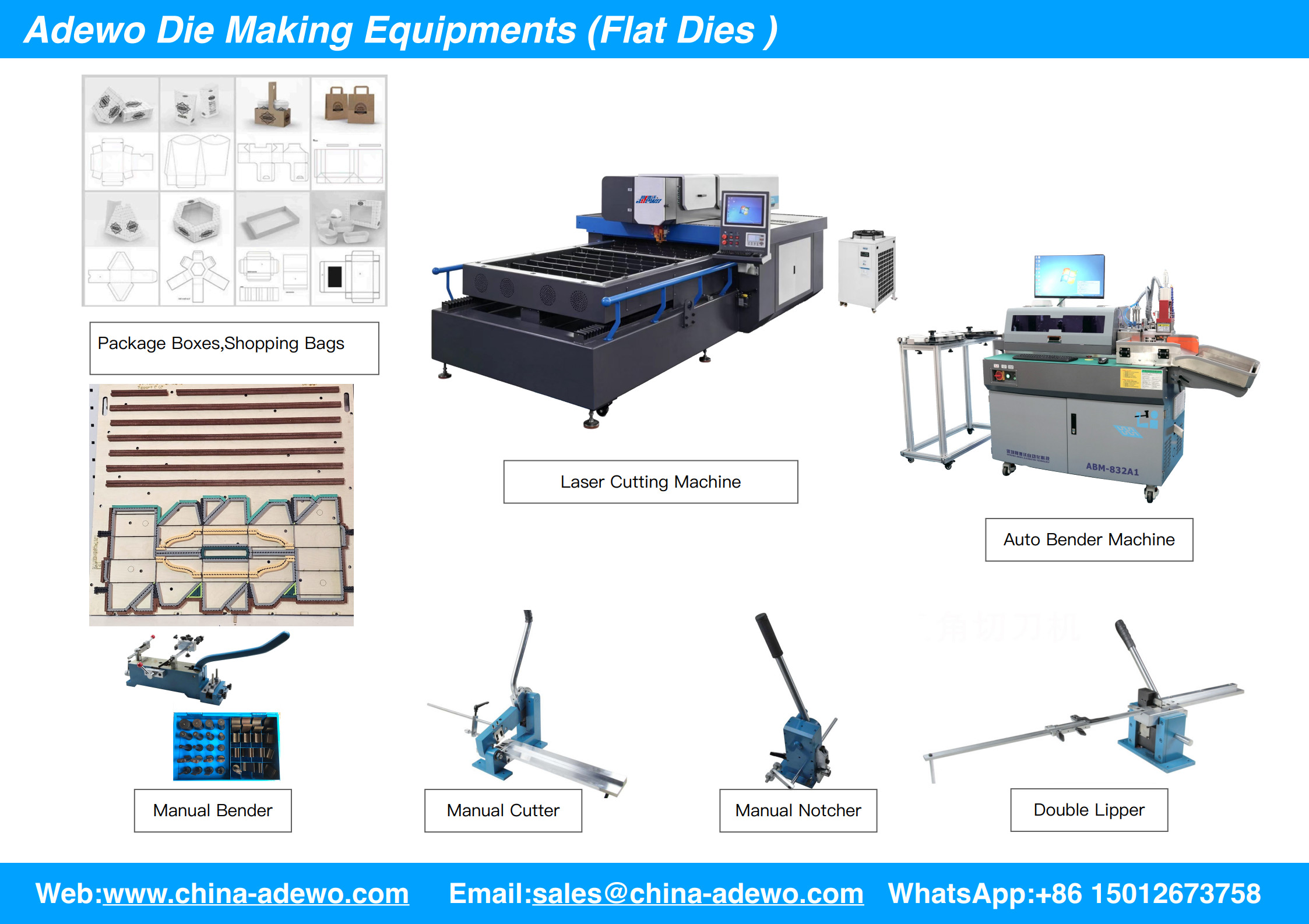
Automated bending, notching, and rubbering reduce human error and speed up repeat orders. For complex carton styles with tight windows or small tabs, automated systems hold tolerances that manual work often misses.
The rubber profiles press the sheet away from the die after cutting. If density, height, or placement is wrong, sheets stick, tear, or require frequent stops to clear waste. Ask how the maker tests ejection on the actual board grade you will run.
Dies need re-ruling, sharpening, and occasional repair. A maker that offers fast re-knifing, spare rubber strips, and remote or on-site troubleshooting keeps your production schedule intact. Delayed support cancels any initial price advantage.
Factor in expected impressions per die, downtime from repairs, board waste during setup, and how often you must replace the die. A slightly higher upfront price often wins when a maker's dies last 30-50% longer and run with fewer stops.
Ask about their experience with crash-lock bottoms, inner partitions, micro-flute laminates, and film-laminated boards. A specialized maker will mention specific bevel angles, crease matrix choices, and pressure adjustments for these structures rather than giving generic reassurances.
Conclusion
Evaluating a folding carton cutting die making equipment manufacturer goes far beyond comparing brochure specs. The first thing to scrutinize is real-world accuracy: before committing, run your most challenging jobs on the machine, measuring repeatability and edge quality over long runs, because a demo on simple straight-line cartons won't expose the drift or vibration that shows up in production. Equally critical is tool steel grade and die life — ask for hardness data, wear curves, and actual die change intervals from existing users, not just theoretical numbers. A supposedly minor difference in steel chemistry or heat treatment can double your die cost per million cartons, so push for empirical evidence rather than marketing claims.
Beyond the machine itself, you need to know whether it can handle your most complicated carton designs — multi-point gluing, tight reverse scores, intricate window cutouts — without slowing to a crawl or requiring constant manual touch-ups. Manufacturer support is another make-or-break factor: when a servo fails or a laser misaligns, response time and spare parts availability matter more than a polite helpdesk. Check their track record during your peak season; if they can't ship a replacement board within 48 hours when you're running 24/7, that discount price is meaningless. Finally, calculate the true cost of going cheap: cheaper machines often hide higher maintenance labor, unexpected downtime, and premium fees for software licenses, training, or even basic consumables. Collect real operational data from two or three reference customers, then compare total cost per finished die over five years — that's the only number that tells you if the manufacturer is worth your investment.
Contact Us
Contact Person: KAELYN LEE
Email: [email protected]
Tel/WhatsApp: +86 15012673758
Website: https://www.china-adewo.com