

Direct Expansion Air Handling Unit Supplier Selection Guide for Commercial HVAC Projects
2026-10-19
Most DX air handling unit selections fail long before installation. The problem isn’t the equipment—it’s how suppliers are screened. This guide lays out a practical, field-tested way to compare direct expansion AHU vendors for commercial projects, then shows where shairko stands against the criteria that prevent midnight callbacks.
Matching DX AHU Capacity to Building Load Profiles Instead of Rule-of-Thumb Estimates
Sizing a direct-expansion air handling unit based on generic square-footage rules often leaves buildings with equipment that cycles too frequently or struggles to hold setpoints during peak conditions. The actual load on a DX AHU changes hour by hour, driven by occupancy patterns, solar gain, ventilation requirements, and internal equipment schedules. When the unit capacity is matched to a measured or simulated load profile rather than a flat estimate, the compressor operates within a more efficient range, reducing short-cycling and unnecessary wear on the refrigeration circuit.
A meaningful approach starts with collecting interval data for the spaces the AHU serves. This data, whether from temporary loggers, building automation trends, or calibrated energy models, reveals how the cooling load peaks and how long it stays near that peak. Instead of selecting a unit that meets an inflated design day figure at full capacity, the equipment can be chosen so that its staged or variable capacity aligns with the majority of operating hours. For example, a unit with multiple compressors or an inverter-driven scroll might spend most of its runtime at 40–70% load, which is often where part-load efficiency peaks.
Accounting for latent load separately also matters. Rule-of-thumb methods frequently treat total capacity as enough, but a building with high ventilation rates or humid outdoor air may need a lower sensible heat ratio than a standard unit provides. Matching the coil’s sensible and latent performance to the actual moisture removal needs prevents oversized equipment from satisfying the thermostat while leaving the space damp. In practice, this means design teams should evaluate hourly load distributions, coil leaving-air conditions, and compressor staging together before finalizing the DX AHU selection.
Factory Performance Testing and How to Interpret Coil and Compressor Data
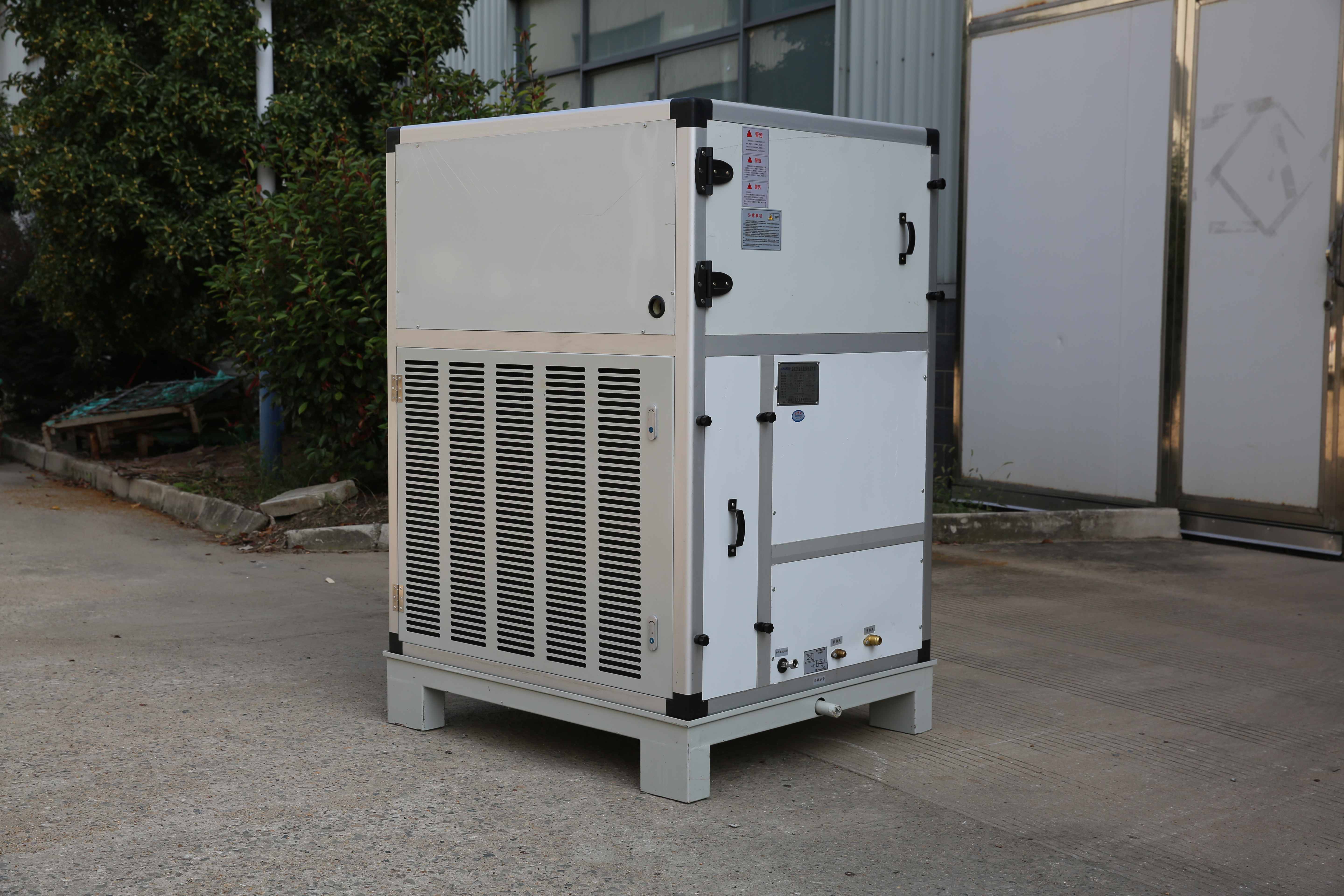
Factory performance testing puts a unit through a controlled sequence that verifies coil heat exchange and compressor operation against design targets. For the coil, you look at entering and leaving air temperatures, refrigerant pressures, and the temperature split across the coil face. A tight split with stable pressures usually means the coil is moving heat at the expected rate. Wide deviations from the published data rarely point to a single cause, so the numbers have to be read together rather than one at a time.
Compressor data only makes sense when suction and discharge pressures are compared with superheat, subcooling, and amp draw under the same test conditions. A compressor can pull normal amps while the discharge temperature climbs if the condenser is starved for air or the charge is off. Factory curves give a narrow band for each parameter, but field readings that fall inside the band still need a sanity check against actual airflow and entering temperatures.
The real skill is separating a coil problem from a compressor problem when the numbers overlap. Low superheat with high suction pressure often points to an overfed coil or a failing expansion device, not a weak compressor. High discharge temperature with normal head pressure could be a lack of subcooling from a restricted liquid line. Comparing the factory baseline to the measured data is useful only when you account for how far the installation conditions have drifted from the lab setup.
Customization Requests That Reveal a Supplier’s Engineering Depth
When a buyer asks for a minor tweak—say, changing the wall thickness on a molded part or adjusting a tolerance on a machined bracket—most suppliers reply with a simple yes or no. But a supplier with real engineering depth treats that request as a conversation starter. They come back with questions about load cases, material flow, or assembly sequence. They might point out that your requested change will create a sink mark on the opposite face, or that a slightly different rib pattern would actually improve stiffness without adding cycle time. That level of back-and-forth isn't just customer service; it's a sign that someone on their side actually understands the physics behind the part, not just the CAD file.
Another tell is how they handle requests that seem impossible on the surface. You ask for a custom connector with an unusual pin arrangement, and instead of quoting a long lead time for a brand-new mold, they suggest modifying an existing insert or using a modular cavity system. They redline your drawing to show how a snap-fit can replace two screws, or how a living hinge can eliminate a secondary assembly step. These aren't just cost-saving ideas—they reveal an internal knowledge base built from years of solving similar problems across different industries. The best suppliers don't hoard that knowledge; they share it in a way that makes your product better, even if it means less revenue for them on that particular order.
Look closely at how a supplier responds when the customization request is vague or poorly specified. A shallow shop will simply quote what you asked for and deliver exactly that—flaws and all. An engineering-driven supplier will push back gently, asking for the intended use, the operating environment, or the failure modes you're worried about. They might propose two or three alternative designs, each with trade-offs clearly explained. That proactive problem-solving isn't a sales tactic; it's a habit that comes from having engineers who actually build and test things. When you find a supplier who treats your customization request as a design challenge rather than a transaction, you've found a partner who can probably handle the next hard problem that hasn't even been drawn yet.
Coordinating DX AHU Controls with Building Automation and Refrigeration Systems
Direct expansion air handling units rarely operate in isolation. The refrigeration circuit, the AHU controller, and the broader building automation system each hold a piece of the puzzle, yet they often speak different languages. Without deliberate coordination, a routine demand for more cooling can trigger compressor cycling that fights the supply fan speed, or a building-wide setback command can leave the DX coil starving for airflow while the compressor keeps running. The result is not just wasted energy but frozen coils, premature contactor wear, and comfort complaints that are hard to trace.
A practical starting point is to map the points of influence: the BAS should own the occupancy schedule and zone temperature setpoints, while the DX unit controller retains authority over refrigerant-side safety and capacity staging. This boundary prevents the BAS from overriding compressor envelopes or ignoring minimum on/off times. At the same time, the refrigeration system needs to expose enough data—suction pressure, discharge temperature, defrost status—so the BAS can anticipate latent load shifts and adjust fan speed or outdoor air dampers before the coil temperature drops. Simple handshakes like a “cooling request” binary point and an analog capacity feedback signal eliminate most integration guesswork.
Coordinating these layers doesn't require proprietary gateways or complex logic. Often, the biggest wins come from tuning deadbands, time delays, and reset schedules so the DX unit isn't chasing every small fluctuation in space temperature. During unoccupied periods, a modest setback of a few degrees rather than a deep shutdown keeps the refrigeration system in a stable state, avoiding morning recovery spikes that force the compressor into maximum capacity while the building is still warming up. Regular review of trend logs from both sides—AHU supply air temperature and compressor run history—can expose mismatches that no single controller would ever flag on its own.
Regional Service and Spare Parts Availability for Mission-Critical Commercial Spaces
When a chiller in a hospital or a backup generator in a data center goes down, waiting days for a replacement part simply isn't an option. Our regional service hubs keep critical spares on shelves within driving distance of major commercial centers—compressors, control boards, sensors, and filters for the equipment most likely to fail under continuous load. Each hub is staffed by technicians who know the buildings in their territory and carry the tools to complete first-visit repairs, not just diagnostics.
Beyond the stocked inventory, we maintain direct lines to regional distributors and a same-day courier network for less common components. For facilities with zero tolerance for downtime, our service agreements include quarterly on-site audits that align local spare sets with the actual equipment installed. That way, a failed part in a process cooling loop or an emergency power system is replaced from a nearby shelf, not ordered from across the country.
Total Cost of Ownership for DX AHUs in High Humidity and Coastal Environments
In coastal and high-humidity settings, the sticker price of a DX AHU tells only a fraction of the story. Salt-laden air attacks aluminum fins and copper tubing within the first year, forcing the compressor to work harder as heat transfer degrades. On top of that, high moisture levels keep drain pans wet for long stretches, inviting microbial growth that clogs condensate lines and drives up coil-cleaning frequency. These hidden costs quickly erase any upfront savings.
Maintenance budgets take an outsized hit when the unit operates near the sea. Electrical connections corrode, cabinet panels develop rust blooms, and fasteners seize—turning routine filter changes into multi-hour jobs. You also end up replacing fans and motors sooner because salt deposits unbalance blades and accelerate bearing wear. Meanwhile, the constant battle against mold means more frequent coil sanitizing and higher chemical expenses, none of which show up in a standard efficiency rating.
A smarter total cost calculation factors in material choices from day one. Epoxy-coated coils, stainless steel drain pans, and sealed electrical compartments add to the initial quote but dramatically reduce unscheduled downtime and part replacements over a 10- to 15-year lifespan. In high humidity and coastal environments, paying extra for corrosion-resistant construction is often cheaper than accepting repeated service calls, shortened equipment life, and the operational chaos that comes with a failed air handler during peak cooling season.
FAQ
Look beyond the datasheet. Verify that the supplier has completed installations of similar tonnage and complexity—ideally with references you can actually call. Ask about their engineering support during design, not just after the order.
The strongest suppliers provide accurate coil selection software, honest lead times, and clearly documented testing procedures. They should also be willing to share psychrometric performance data at part-load conditions rather than only at rated full load.
Commercial buildings rarely operate at full cooling load. A unit that performs well at 50% or 75% capacity will reduce energy waste and prevent humidity control problems, so ask for part-load COP or EER curves, not just a single design point.
Confirm that the DX AHU can communicate with the project's building automation system using open protocols like BACnet or Modbus. Also check who is responsible for programming the staging, safeties, and airflow interlocks—the supplier or the controls contractor.
Very important. A long warranty means little if the supplier has no local technicians or spare parts stock. Ask for a list of regional service partners, typical response times, and whether startup commissioning is included in the base price.
Look for flexibility in casing materials, coil coatings for corrosive environments, double-wall construction, access door placement, and fan types. The supplier should also be able to adjust the unit footprint to fit existing mechanical rooms without huge cost premiums.
Prioritize total lifecycle cost. A lower upfront price often means thinner casing, less efficient fans, and minimal factory testing. Over 15 years, energy and maintenance savings from a better-built unit usually outweigh the initial difference.
Conclusion
A credible direct expansion air handling unit supplier rarely leads with a catalog rating. Ask the vendor to walk through your building's actual load profile—morning pull-down, shoulder-season part-load, weekend setback—rather than accepting a square-footage estimate. That conversation quickly separates firms that size coils and compressors for real sensible and latent peaks from those who default to a 400 CFM per ton shortcut. Once the thermal discussion moves to the factory, demand raw performance test data and know what to look for: coil bypass factors at high entering wet bulb, compressor capacity at 115°F ambient, circuiting that prevents liquid slugging during low-load cooling. If a supplier hesitates on these numbers, move on. Use customization requests as a probe: ask about reheat coil placement, hot gas bypass routing, double-sloped drain pans, or coastal coil coatings. A supplier with genuine engineering depth will clarify trade-offs and pressure drops, not just say yes to every option.
Controls compatibility is often where a DX AHU purchase unravels. Push for an as-built points list and confirm the unit can hand off to your building automation system and any parallel refrigeration or condenser water loops without a proprietary gateway. You need alarm mapping for compressor safeties, discharge air reset, and occupancy-based staging to be visible in your existing front end. Then look at the service footprint. For mission-critical commercial spaces, a local warehouse with compressors, expansion valves, and control boards makes the difference between a four-hour repair and a week of rented cooling. Finally, in high humidity or coastal environments, first cost is misleading. Corrosion-resistant coil coatings, heavier cabinet paint, double-wall access doors, and longer runtime in dehumidification all influence long-term spend. Evaluate lifecycle energy use, filter and belt replacement, coil cleaning frequency, and expected compressor life under salt-laden air. Suppliers who openly discuss these failure modes and regional parts stocking tend to deliver far better outcomes than those who tout a low bid.
Contact Us
Contact Person: Crystal
Email: [email protected]
Tel/WhatsApp: 8613524235353
Website: https://www.airkohvac.com