

Custom UV Marble Sheets Hot Stamping Foil Supplier: What to Look for Before You Order
2026-10-26
Ordering custom UV marble sheets hot stamping foil isn’t just about picking a pattern—it’s about knowing which supplier won’t leave you with peeling edges or mismatched batches. Before you commit, here’s the unfiltered checklist from GUMPTION that separates reliable partners from costly mistakes.
Why Foil Flexibility Matters More Than You Think on Marble Textures
Most people assume the visual weight of a marble texture comes from color contrast alone, but the physical give of the foil is doing a lot of quiet work behind the scenes. A stiffer foil tends to bridge across the shallow depressions that mimic natural stone pores and micro-fissures. Instead of settling into those tiny valleys, it stretches flat over them, leaving air pockets that later show up as odd, sharp glints or fine cracks once the finish is burnished. That kind of failure is rarely obvious up close during application; it shows up later under angled light, when the surface should be reading as softly dimensional but instead looks interrupted.
Flexible foil, on the other hand, moves almost like a liquid skin. You can press it into a vein line without fighting the material, and it will hold the memory of that subtle groove rather than springing back. This matters especially when you’re layering translucent glazes over the foil to deepen a particular area. If the foil has lifted even a fraction of a millimeter, the glaze will pool unevenly around the lifted edge and create a halo effect that reads as a mistake rather than a natural mineral bloom. With a truly supple foil, you can work wet into wet, re-wetting the surface and reshaping the metallic reflection without worrying that the sheet will tear or lose adhesion at the edges.
There’s also an underrated tactile element: the speed of your hand changes how a sheet behaves. A foil that flexes easily gives you a wider margin for error when you’re dragging a soft brush across a curved vein or pressing into a tight corner. You can work slower, pausing to judge the light, and the foil won’t stiffen or buckle. The result is a marble texture that doesn’t just look convincing from a distance but holds up when someone leans in and notices how the metallic veins seem to sit inside the surface rather than float on top of it.
The Hidden Cost of Skipping a Custom Color Match Test
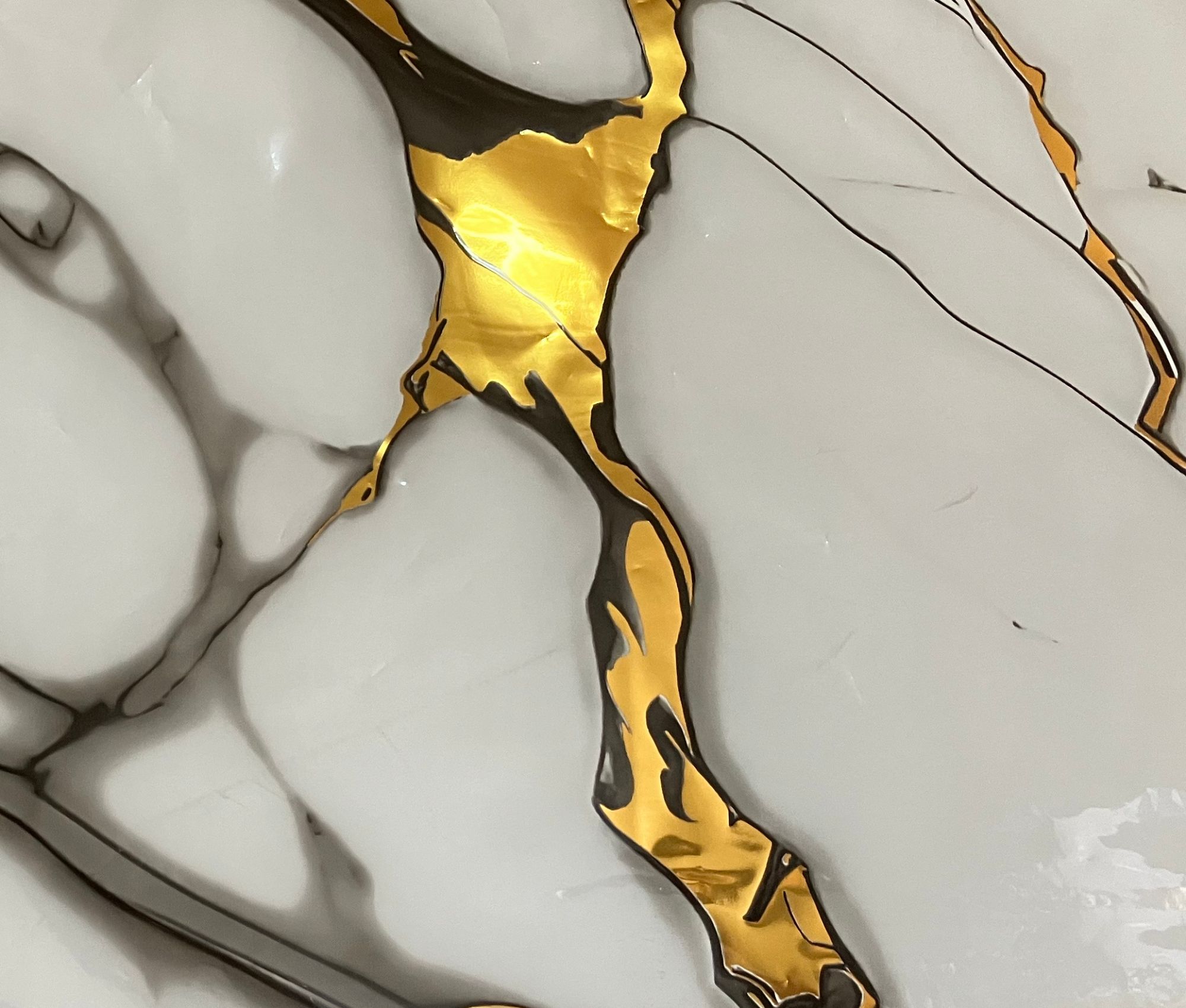
Most people only find out the hard way that “close enough” is not a color. A panel that looked right under the showroom lights can shift completely in natural daylight, leaving a repair or product run with a visible blotch that no amount of polishing will fix. Skipping the custom color match test saves a little time upfront, but it quietly sets up a chain of rework that eats through labor hours and material budgets faster than most shops expect.
The real sting comes later, when the mismatched part reaches a customer. Returns, complaint calls, and rescheduling don’t just cost money—they burn the trust that keeps a business alive. One bad batch can undo months of careful reputation building, especially when the color mismatch shows up in a high-visibility spot. A quick test would have caught the drift before it ever left the bench.
There’s also the waste nobody likes to talk about. Every failed batch means more pigment, more solvents, more energy, and more disposal, all because a small sample wasn’t sprayed or applied first. The custom color match test isn’t a luxury step; it’s the cheapest insurance against the compounding cost of doing the same job twice.
What a Supplier’s Past UV Marble Projects Reveal About Their Limits
A supplier’s UV marble portfolio rarely tells the full story until you look beyond the glossy photos. In many cases, past projects expose gaps in curing consistency—especially with darker or heavily veined sheets where uneven UV exposure leads to patchy gloss or premature yellowing. Those flaws don’t show up in a hand sample, but they repeat across installations once the process is pushed to scale.
Another telltale sign is how the supplier handled edge profiles and cut-to-size orders in previous jobs. Some shops are comfortable only with flat, rectangular panels; once a project demanded mitered edges, backlit panels, or tight-radius curves, the failure rate climbed and delivery slipped. That pattern often indicates limited in-house finishing capability or overreliance on third-party fabricators.
Buyers who dig into a supplier’s completed UV marble work—rather than just their sample boards—can spot these boundaries early. Client complaints about color drift, delamination, or prolonged lead times are not isolated incidents; they are signals of where the supplier’s process control starts to break down.
How to Spot Inferior Hot Stamping Foil Before It Ruins Your Run
A quick visual pass over the roll can reveal more than you'd expect. Inferior hot stamping foil often shows uneven pigment distribution—thin patches, streaking, or a mottled sheen that catches light differently across the surface. Put the roll under a bright, angled light and unspool a short length. If the coating appears powdery or flakes off before it ever meets heat, that's a red flag. Good foil should feel smooth and consistent, with no visible cracks or pinholes when you flex a sample gently.
Test the release and adhesion on the actual substrate you'll be running, not a generic test card. Cut a small square, set your press to the low end of the recommended temperature range, and stamp once. Peel the carrier slowly. If the foil lifts in spots, leaves a halo around fine text, or requires extra dwell time just to transfer a solid block, the batch is likely inconsistent. Compare two or three stamps from different sections of the roll—variance between the outer and inner layers often signals poor storage or a rushed coating process.
Don't ignore the carrier film itself. Wrinkles, edge nicks, or a brittle feel usually point to mishandling or age, and both will cause feeding problems mid-run. Also check the rewind tension on the roll. If it's wound too loose or too tight, you'll spend more time clearing jams than stamping. Catching these signs before you load up means fewer wasted sheets and no last-minute scramble when the foil starts breaking down halfway through a job.
Lead Time Promises Are Useless Without These Two Details
A lead time promise feels reassuring until the order slips a week past the date you quoted. The problem usually isn't the timeline itself—it's that two details were never nailed down. One is the actual start point: does lead time begin when the purchase order lands in your inbox, or when engineering finally signs off on the specs? The other is the end point: does it mean the product leaves your dock, or when it arrives at the customer's receiving bay? Without those anchors, any promise is just a guess wearing a confident number.
Most teams default to lead time meaning "from order confirmation to shipment," but your customer may be counting from the first email asking for a quote. That gap can swallow weeks. Instead of speaking in vague terms, define the two boundaries out loud: "Lead time runs from the date we confirm your order in writing to the date the shipment leaves our facility." That single sentence eliminates assumptions that cause late deliveries and angry calls. If the customer needs a different start or end point, negotiate it explicitly—never leave it to interpretation.
A useful trick is to pair every lead time promise with a small map: "7 days from confirmed order + 3 days transit = 10 days to your door." This forces everyone to see the start and end points, not just the middle number. It also exposes where the real delays hide—approval loops, batch processing, carrier handoffs. When a lead time fails, trace it back to which boundary was fuzzy, and you'll usually find the fix is a clearer handshake, not a faster machine.
The Real Reason Minimum Order Quantities Vary So Wildly
Minimum order quantities rarely come from a fixed price list. A supplier might quote 500 units for one style and 5,000 for another because the real variable is how much of the production process gets devoted to a single run. Custom tooling, switching dyes, recalibrating machines, and the cost of raw materials that cannot be reused all fold into that number. If a product needs a dedicated mold or a unique fabric batch, the factory has to recover those upfront costs before making a profit, so the threshold rises sharply.
Inventory risk also plays a bigger role than most buyers realize. A large manufacturer running near capacity will reject a small order because stopping a high-volume line for a short run costs more than the order is worth. Smaller workshops, on the other hand, often accept lower quantities because their fixed expenses are lighter and they need to keep cash flowing. The same product can therefore carry wildly different MOQs depending on who makes it, when you ask, and how much flexibility you show on delivery dates or packaging.
FAQ
Custom UV marble sheets are rigid panels with a UV-cured coating that mimics natural marble patterns. Hot stamping foil adds metallic or pigmented accents through heat and pressure, so the foil needs to bond properly with that cured surface. Before ordering, you want to confirm the supplier understands how the foil interacts with the UV layer—some coatings are too slick or too soft to hold a crisp transfer.
Go beyond just picking a pattern. Confirm sheet thickness, size tolerances, edge finishing, and whether the UV coating can be applied in matte, gloss, or satin. For the foil, specify the exact color range, roll width, and whether you need re-stamping resistance. If you have a physical sample or a Pantone reference, share it early to avoid back-and-forth later.
Ask for accelerated aging data or at least a scratch and abrasion test result. A good UV layer should resist yellowing, peeling, and micro-cracking after exposure to light and humidity. You can also request a small test panel and run your own tape-pull or coin-scratch test before approving the full batch.
Marble patterns often have subtle raised or brushed areas that can create uneven pressure during stamping. You want a foil with a strong but flexible adhesive layer, and the supplier should be able to show you results on embossed or textured zones, not just flat areas. A quick bend test on a stamped corner can reveal whether the foil will flake or crack under normal handling.
Most suppliers set a minimum based on the coating line setup and foil printing costs. For fully custom UV marble sheets, expect a higher MOQ because the pattern may need a dedicated cylinder or digital file. Don't assume a low price quote includes small batches—ask for the exact unit count, whether overruns are allowed, and if combining multiple patterns under one order can help you reach the threshold.
At minimum, they should send a physical swatch of the marble pattern on the actual substrate, plus a stamped foil test strip on that same swatch. Digital mockups are fine for initial approval, but they won't show you how light catches the UV gloss or how the foil edge looks in person. If a supplier pushes back on sending physical samples for a custom order, that's usually a red flag.
The biggest mistake is treating the UV sheet and the foil as separate purchases without testing them together. Another is not asking about batch-to-batch consistency for both the marble pattern and the foil color. Always get a written confirmation of the lead time, packaging method, and what happens if the material arrives with defects. A clear returns or rework policy upfront saves more time than chasing a cheaper price.
Conclusion
When you're sourcing hot stamping foil for custom UV marble sheets, the first thing that separates a reliable supplier from a problem is how the foil handles the irregular, layered surface of a marble texture. A foil that's too stiff will crack or refuse to settle into the fine veins, leaving you with dull spots or uneven coverage. That's why flexibility tests on actual marble-textured samples matter more than a glossy spec sheet. Equally telling is a supplier's reaction when you ask for a custom color match trial. If they wave it off or charge an absurd fee for a single drawdown, expect hidden costs later—batch-to-batch drift, reprints, wasted substrate. And don't just take their word on experience; ask to see past UV marble projects, specifically ones with deep embossing or multi-tone veins. Many suppliers can handle flat foil, but marble demands a different level of coating control.
Before you sign anything, run a simple abuse test on the foil: crease it, scratch it lightly, and check adhesion on a UV-cured surface. Inferior foil often looks fine on a swatch but lifts at the edges or fractures during high-speed stamping, ruining an entire run before you notice. Lead time promises mean nothing unless the supplier breaks down the two critical details: when the raw foil actually enters production and which carrier is handling the final leg. Without those, "three weeks" can quietly become six. As for minimum order quantities, the wild variation usually comes down to whether the supplier stocks base film or has to commission a custom coating run. Smaller MOQs often mean they're using off-the-shelf base with a color tweak, which is fine for testing but not always for production consistency. Ask for a pilot roll before committing; it's cheaper than discovering the limits on your own press.
Contact Us
Contact Person: Hsien
Email: [email protected]
Tel/WhatsApp: +86 57387072688
Website: https://www.gsfilm.cn