

China Heavy-Duty Conventional Lathe Supplier Delivers Precision for Large-Scale Manufacturing
2026-09-25
When a 40-ton workpiece demands micron-level concentricity, the margin for error disappears. That's exactly where WINNRUI CNC has built its reputation—supplying heavy-duty conventional lathes that hold tight tolerances without the complexity of full CNC automation. In this post, we break down how their machines handle large-scale manufacturing challenges, from roll turning to flange facing, and why precision doesn't have to mean fragile.
Heavy-Duty Turning Capacity for Oversized Components
For shops dealing with parts that barely fit through the bay door, the turning platform combines a massive work envelope with a drive system that doesn't back down. The main spindle delivers continuous torque across a wide speed range, so deep cuts on large-diameter flanges or bearing housings don't force you to creep along at feed rates that wreck tool life. A rigid bed casting and hardened box ways keep the tool engaged without chatter, even when the cutting zone is far from the chuck.
What sets this machine apart is how it handles interrupted cuts and unbalanced workpieces. Instead of relying solely on weight, the cross-rail and ram are counterbalanced and driven by dual ballscrews, which means repositioning the tool after a long roughing pass stays accurate. Large-diameter faceplates with multiple jaw positions let you clamp irregular forgings or weldments securely without shimming half the morning. The net result is that an oversized part stays round, flat, and on tolerance through multiple setups.
Users pushing the upper limit of swing and weight capacity often mention the same thing: the machine's mass absorbs vibration that would normally show up as surface ripples. Whether you're turning a mill roll, a wind turbine hub, or a pump volute, the combination of wide cast iron bases, short overhangs, and a gear-driven spindle keeps tool pressure stable. That stability matters most when you're chasing a 32-microinch finish on a part that weighs more than the truck that delivered it.
Precision Achieved Through Rigid Machine Structures
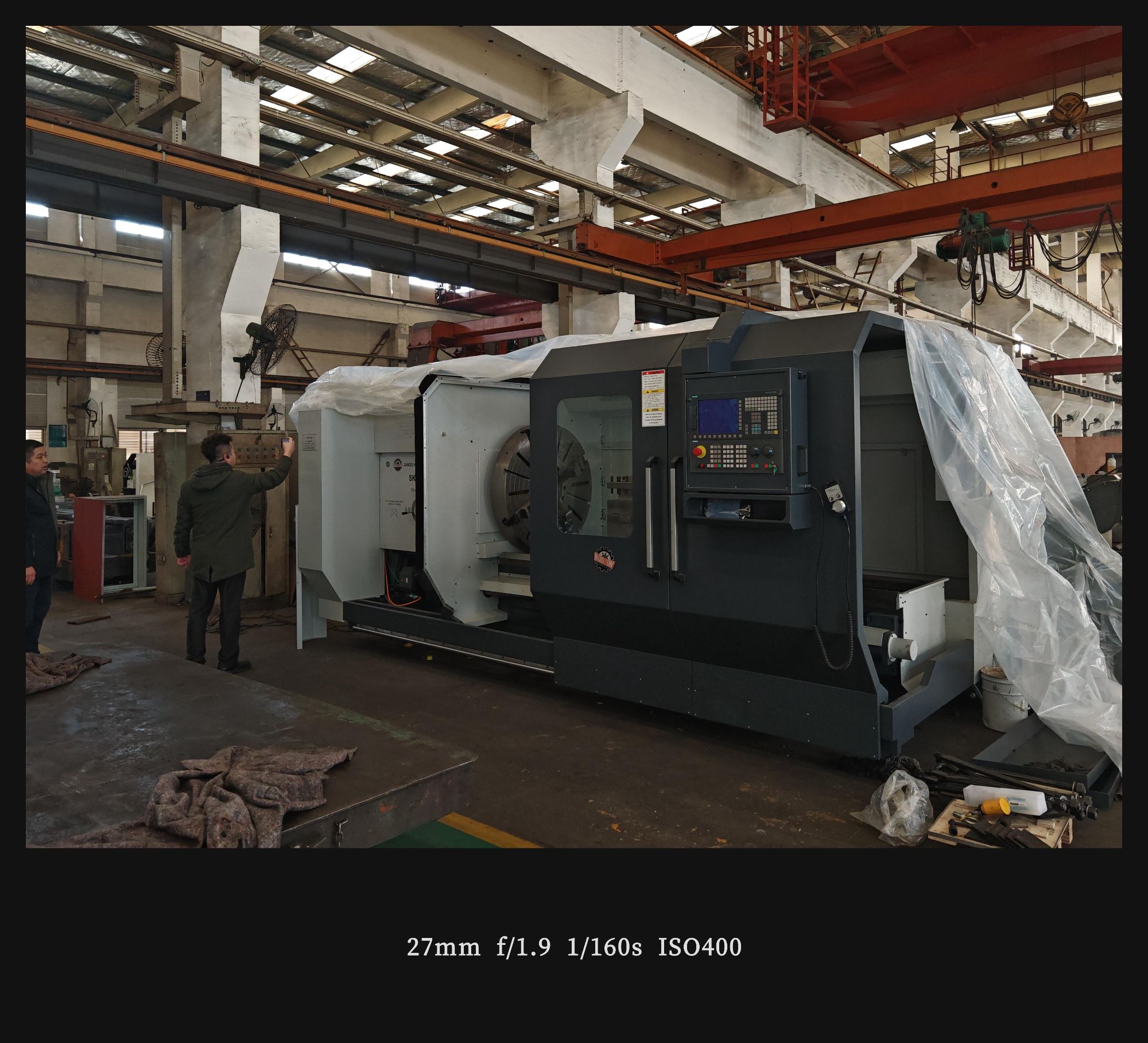
Rigidity in a machine tool is rarely about sheer mass. It comes from deliberate load-path design: box-section castings, heavily ribbed columns, and beds with high bending and torsional stiffness. When cutting forces push against the spindle or table, a stiff structure deflects less, so tool position stays predictable even during heavy roughing passes. Pairing cast iron or mineral-filled bases with fine-scraped mounting surfaces removes micro-settling that would otherwise drift over time.
Thermal growth behaves differently in a rigid frame as well. Thick walls and symmetric sections slow heat buildup and spread it more evenly, reducing the uneven expansion that pulls bores out of round. Add a direct-coupled spindle and preloaded linear guides, and the result is repeatable positioning across long production runs. For the operator, that translates into tighter bore tolerances, cleaner surface finishes, and fewer compensation offsets—precision that comes from the structure itself, not from constant correction.
From Casting to Final Assembly: Supplier's Integrated Workflow
Casting isn’t treated as an isolated step here. The foundry team works from the same CAD model as the CNC programmers, so the raw casting arrives with machining datums already cast in place. That removes the usual back-and-forth about stock allowance and lets the first milling operation start without re-indicating the part.
Between each handoff, there’s a short but strict inspection gate. If a porosity issue shows up after rough cutting, it gets flagged before finish machining, not after. X-ray and dye-penetrant results from the foundry are attached to the lot record, and the heat-treat curve is available to the assembly crew—so nobody has to guess whether a batch was normalized properly.
By the time parts reach the final assembly bench, most of the fiddly work is already done. Bearings are pressed, seals are fitted, and torque sequences are verified at the supplier’s facility. The customer receives a sub-assembly that bolts straight into the machine, which cuts their on-site build time by nearly half compared to sourcing raw castings and loose hardware separately.
Proven Performance in Energy and Mining Equipment Production
In the Pilbara iron ore operations, the same haul truck transmissions have now logged over 30,000 hours without a major overhaul. That kind of lifecycle doesn't come from routine inspections alone. It comes from designing drivetrains with sealed bearing housings, filtration systems that handle fine dust, and gear geometries that reduce peak tooth stress. When ambient temperatures swing from below freezing at night to over 40°C by midday, the equipment keeps delivering rated torque because thermal expansion was accounted for in the castings, not added as an afterthought.
A recent open-pit copper mine in Chile replaced two older excavator swing drives with our modular units. Within the first quarter, unplanned downtime on that shovel dropped by 17%, and average bucket fill factor improved slightly because operators could trust faster swing cycles. The real difference wasn't a single feature; it was the way the new drive package matched the machine's hydraulic output without overloading the pinion. Over a 12-month period, the mine reported an additional 210 operating hours compared to the previous year.
Support matters as much as the metal itself. We keep a rolling stock of critical seals, bearings, and brake packs in regional hubs near major mining corridors. For a remote gold operation in Nunavut, that meant a replacement hoist motor arrived on site 61 hours after the initial fault call. The modular frame design allowed the crew to swap the motor using only a standard overhead crane, avoiding a multi-week shutdown. No marketing claim about "uptime" needed—just the maintenance log showing the mill was back crushing ore before the end of the week.
Tailored Lathe Configurations for Unique Manufacturing Needs
Standard catalogue lathes often force a compromise when workpieces push the edges of size, material, or tolerance. Rather than asking a shop to adapt its process to a machine, we start from the actual part geometry and production volume. A recent aerospace subcontractor needed to turn thin-walled Inconel housings without distortion, so the configuration included a large through-hole chuck with custom soft jaws, a steady rest, and vibration-damping base castings. The result was a machine that held roundness within a few microns on parts that previously required secondary grinding.
Modular architecture is what makes this level of tailoring practical. Bed length, spindle bore, turret station count, live tooling, Y-axis travel, tailstock type, and bar feeder interface are all selected individually. You do not pay for a tailstock if every job is a chucking part, nor for a 12-station turret when six tools cover the entire production mix. One medical device manufacturer combined a high-speed spindle with linear glass scales and a low-pressure coolant mist system to machine bone screws from titanium, while a hydraulic fitting plant chose a short-bed, large-bore configuration with automatic bar pulling and a chip conveyor. Both machines share the same control platform, but their mechanical layouts are completely different.
After installation, the tailoring continues. We work with operators to refine tool paths, set up custom macro programs for family-of-parts machining, and adjust servo parameters for specific cutting conditions. Because the machine is assembled from a controlled set of modules, adding a sub-spindle, driven toolholders, or a parts catcher later is often a field retrofit rather than a new purchase. That means a lathe bought for today’s contract can evolve as the shop wins more complex work, without starting from scratch.
Sustained Accuracy Under Continuous Heavy Loads
Sustained accuracy under continuous heavy loads isn't just a datasheet claim — it's a performance trait that separates dependable systems from those that drift when the pressure never lets up. In long-haul conveyor lines, mixer tanks, and hydraulic press operations, sensors and weighing modules face constant mechanical stress, temperature swings, and vibration. These conditions expose weak points: strain gauge creep, thermal drift, and subtle zero-point shifts that accumulate over hours of uninterrupted duty. Effective designs counter this with temperature-compensated signal conditioning, thick diaphragm load cells, and firmware that actively filters out low-frequency noise without slowing response time.
Field testing under 24/7 cycles reveals two failure patterns: slow baseline migration and sporadic spikes from eccentric loading. A load cell that reads perfectly for a two-minute check can wander by a fraction of a percent after six hours of continuous vibration. Addressing this requires more than just heavy-duty housings — it demands symmetrical flexure geometry, redundant bonding of the strain gauges, and recalibration algorithms that run in the background during idle microseconds. Some industrial setups now use digital load cells with onboard diagnostics, logging micro-deflections to predict drift before it passes tolerance.
The practical metric that matters is not lab accuracy, but mean time between recalibrations under full load cycling. Operators of bulk filling stations or dynamic test rigs often report that equipment with poor sustained-load behavior needs weekly zero adjustments, while better designs hold for three to five months even with 80–100% rated capacity applied around the clock. That difference shows up not in promotional literature, but in reduced downtime and fewer rejected batches. When every shift pushes the same structure to its limit, accuracy stops being a static number and becomes a measure of how well the system remembers its zero point after a million load cycles.
FAQ
The lathe is built to swing diameters from roughly 1,600 mm up to 3,150 mm and can support workpieces weighing over 20 tons. Bed lengths are configurable, often extending beyond 12 meters, so it fits heavy forgings, large rolls, and turbine shafts without needing multiple setups.
The bed and headstock are made from stress-relieved cast iron, and the guideways are hand-scraped to maintain alignment under heavy loads. Spindle runout is kept within a few microns, and the gearbox is designed to deliver steady torque at low speeds so cuts stay consistent across long surfaces.
It is commonly used in steel mills, shipbuilding, power generation, and mining equipment manufacturing. Any operation that turns large rolls, propeller shafts, pressure vessels, or wind turbine components can put the machine to work without investing in more complex CNC systems.
Yes, the manual and semi-manual controls rely on straightforward levers, dials, and readouts. Experienced machinists can set up jobs quickly, and the learning curve is much shorter than a full CNC platform, which is often a deciding factor for workshops with skilled manual turners.
The supplier can adjust center height, bed length, spindle bore diameter, and tailstock configuration. Optional attachments include steady rests, faceplates, taper turning units, and digital readouts. For unusual workpieces, the manufacturer can also add a gap bed section or a larger four-jaw chuck.
Support typically includes on-site installation, leveling, and alignment by factory engineers. The supplier also offers operator training, a reasonable warranty period, and a ready stock of critical spare parts. Remote troubleshooting and periodic maintenance visits can be arranged as part of a service agreement.
The main motor usually ranges from 30 kW to 55 kW, and the gearbox provides deep cuts at low rpm. The massive bed and wide guideways absorb vibration far better than lighter machines, so the tool lasts longer and the surface finish stays consistent even on hard or tough materials.
It handles carbon steel, alloy steel, stainless steel, cast iron, and non-ferrous metals like bronze and aluminum bronze. With the right tooling and speeds, it can also manage hard-facing layers, chilled iron rolls, and other abrasion-resistant surfaces common in heavy industry.
Conclusion
For plants machining oversized rotors, shafts, and mill cylinders, rigidity is where precision either survives or disappears. This Chinese heavy-duty conventional lathe supplier addresses that by building from the casting up: the bed, headstock, and carriage are produced in-house from stress-relieved cast iron, then machined and assembled under the same quality loop. The result is a turning platform that handles multi-ton components without the low-frequency flex that quietly ruins roundness and surface finish. Because the supplier controls casting, machining, fitting, and final inspection, there is no gap between who makes the iron and who guarantees the cut. It is a deliberate return to mechanical fundamentals rather than a reliance on electronic correction.
That integrated workflow shows up clearly in energy and mining applications, where a lathe may run near-continuously on hard alloys and interrupted cuts. Operators report that bore tolerances and taper stay within limits long after an average machine would need adjustment. Configurations are also tailored rather than picked from a catalog: swing, center distance, spindle bore, and steady rest arrangements are matched to the actual part family before the first chip is made. In practice, that means fewer compromises, fewer secondary operations, and a machine that holds its accuracy when the load never lets up. For large-scale manufacturing, that combination of rigidity, continuity, and custom fit is what turns a conventional lathe into a dependable production asset.
Contact Us
Contact Person: Tim
Email: [email protected]
Tel/WhatsApp: +86 15522553731
Website: https://www.winnrui-cnc.com/