

Calcium Sulfate Antistatic Floor Solutions for Static Sensitive Workspaces
2026-11-19
Static-sensitive environments rarely forgive a single misstep, and the floor beneath your feet often decides whether that misstep happens at all. Calcium sulfate antistatic flooring has quietly become the backbone of modern electronics manufacturing, healthcare imaging rooms, and server halls, but not all solutions handle the same way. Lipin Floor approaches this challenge differently: instead of treating conductivity as a checklist item, the focus stays on how the surface behaves under real loads, humidity shifts, and daily wear. In this guide, we break down what makes a calcium sulfate antistatic floor genuinely reliable, and why the right spec can protect both your equipment and your people long before a spark ever gets the chance to form.
The Real Reason Static-Sensitive Workspaces Need Floor-Level Control
Most discussions about electrostatic discharge focus on wrist straps, mats, and grounding cords. The less obvious issue is that a bench-top setup misses the moment when a technician rolls a chair, drags a cart, or simply walks across the room. Those motions generate charge on wheels, shoes, and equipment cabinets. If the floor itself is not part of the discharge path, every movement reintroduces a voltage differential that no wrist strap can correct, because the strap only keeps the person at the same potential as the bench, not the approaching object.
Floor-level control matters because it turns the entire room into a gradual charge drain rather than a collection of isolated safe zones. A properly specified static-dissipative floor sits in a narrow resistance range: high enough to avoid a sudden short, low enough to bleed charge away before it reaches component-damaging levels. This is not about passing an audit snapshot. It is about what happens during ordinary movement, when a board is in one hand and the other hand reaches toward a tote that just arrived on an ungrounded cart. Without floor continuity, the fault is already built into the workflow.
Calcium Sulfate Cores Are Not Just Another Panel Option
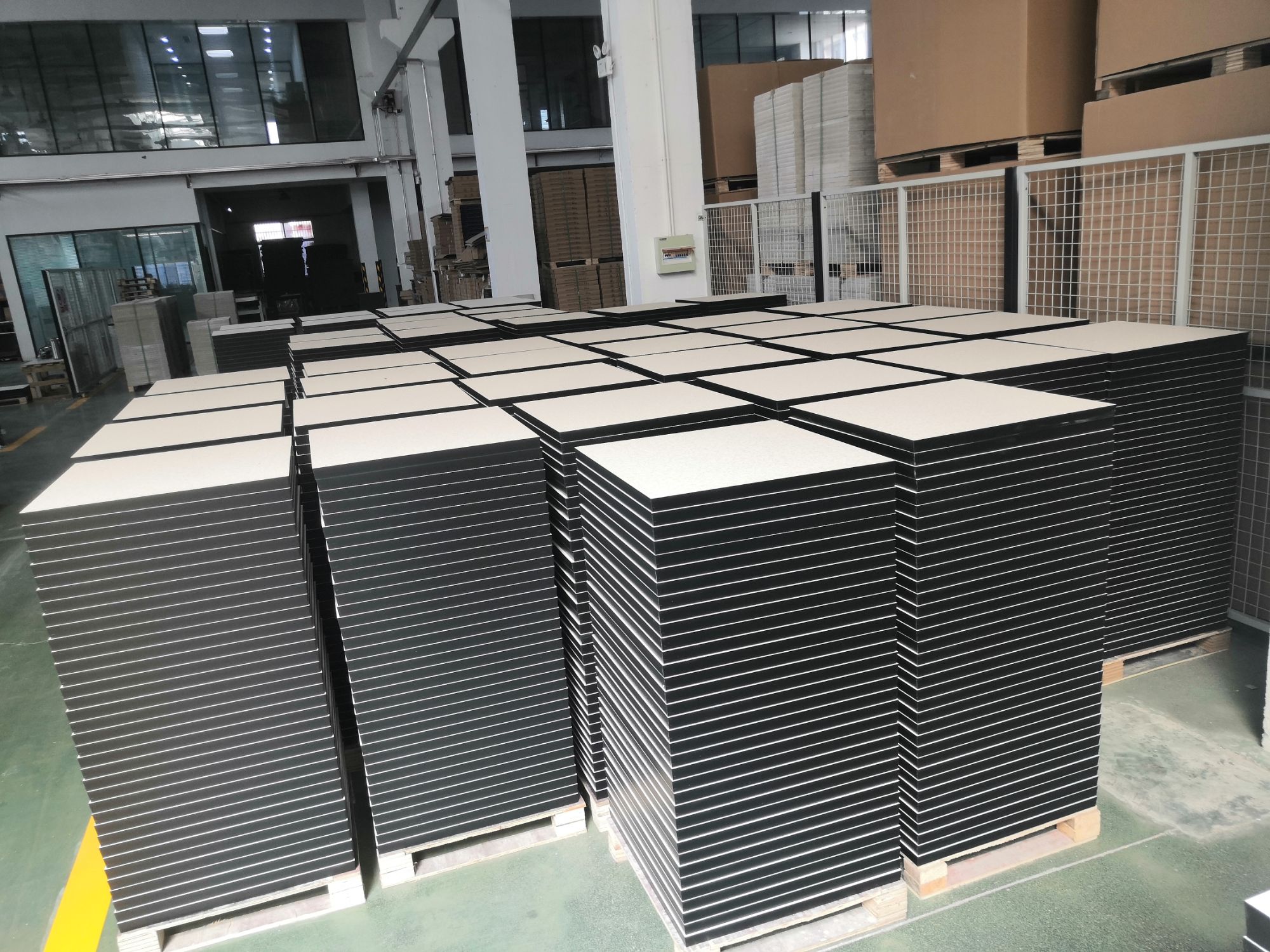
A lot of panel products make the same promises until they meet a wet subfloor or a steamy bathroom. Calcium sulfate cores behave differently because the mineral core itself doesn’t swell, soften, or feed mold the way cellulose and some gypsum blends can. That single difference moves it out of the “just another option” category and makes it a safer default for areas where moisture and fire resistance are non-negotiable.
The difference shows up during installation too. Edges stay crisp instead of crumbling, fasteners bite evenly without blowing out the back, and the board doesn’t relax or shrink after it’s hung. For anyone who has had to re-tape a seam or float a patch behind a tile setter, that kind of dimensional stability reads less like a spec sheet claim and more like time saved on the job.
Long-term, the real payoff is what doesn’t happen: no callback for cracked grout, no peeling finish at the base of a shower wall, no hidden softening behind a backsplash. When you compare panels only by thickness and price, these are the failures you inherit. Calcium sulfate cores quietly remove several of them before the finish ever goes on.
Finding the Right Electrical Resistance for Your Equipment Mix
Matching resistance values across different devices often feels less like a formula and more like a balancing act. A coil that works perfectly in one setup can run noticeably hotter or cooler when paired with a different mod, battery, or airflow configuration. The practical approach is to treat the printed ohm rating as a starting point rather than a fixed destination. Small shifts in wire material, diameter, and even how tightly the coil is spaced will pull the actual performance away from the label on the pack.
Instead of chasing a single ideal number, pay attention to how the full chain behaves after a few minutes of use. If a build drains cells faster than expected while delivering only lukewarm vapor, the resistance may be sitting too low for that particular mod's output curve. On the other hand, a setup that struggles to reach its temperature sweet spot often benefits from dropping a few tenths of an ohm or switching to a wire with lower mass. The goal is a middle ground where the power source, atomizer, and coil all settle into a rhythm without constant adjustments.
Take notes on what actually works with your specific mix rather than borrowing settings from unrelated gear. Two devices with identical printed resistances can pull current very differently because their internal regulation and cell health aren't the same. Over time, you'll build a short list of ranges that feel reliable for each pairing. That hands-on record beats any generic chart, since it reflects how your equipment behaves in the real world, not in a controlled test bench.
Small Installation Missteps That Can Erase Antistatic Performance
A common issue starts with the copper grounding strip. If the adhesive side picks up dust from the subfloor or gets peeled back even slightly during tile placement, the contact area shrinks to a fraction of what the spec expects. Technicians sometimes press the tile edge down hard, assuming that pressure alone will restore the connection, but a curled strip or a gap left at the seam quietly breaks the path. Once the finish layer goes on, the floor looks right while the resistance between the surface and the ground point drifts upward.
Another overlooked spot is under the pedestals and stringers. A small piece of plastic sheeting, an off-cut from a vapor barrier, or even a thick layer of construction dust can sit between the conductive base and the support. When that happens, the vertical path from the panel through the pedestal never closes. The fix is not just sweeping the area—it requires checking that each pedestal foot actually touches the conductive primer or copper tape before the panels lock in.
Fastener choices cause their own quiet failures. Replacing a supplied conductive screw with a standard zinc or painted one introduces a high-resistance junction, especially where the screw threads cut through the panel. In some installations, crews add a thin foam underlayment for comfort without verifying its electrical properties. That single layer can act as an insulator across the entire floor, leaving the antistatic specification intact only on paper.
Labs, Cleanrooms, and Assembly Lines Each Put Different Pressure on Floors
Lab floors rarely see heavy forklift traffic, but they take a quiet beating from spilled solvents, rolling carts, and the occasional dropped glassware. Chemical resistance and easy cleanup matter more here than raw load capacity, and even small cracks can become contamination traps that skew sensitive measurements.
Cleanrooms flip the priority list entirely. The floor might not carry much weight, yet every footstep can shed particles, and the wrong coating can off-gas or build static. These spaces demand seamless surfaces, low outgassing, and enough conductivity to keep electrostatic discharge from wrecking a batch.
Assembly lines, by contrast, punish floors with vibration, constant foot traffic, and heavy jigs or carts moving along fixed routes. Impact resistance, levelness, and long-term wear under repetitive motion become the real tests, because a floor that shifts or pits can throw off alignment and slow the whole line.
Seasonal Care Habits That Keep Dissipative Flooring Dependable
As humidity drops in winter, static buildup on dissipative flooring becomes harder to control. Wiping the surface with a lightly dampened microfiber mop twice a week helps the material release charge instead of trapping it under dry dust. Switch to a pH-neutral cleaner that leaves no insulating film, because even a thin residue can interrupt the controlled path to ground.
Warm, humid months bring their own issue since cleaning solutions evaporate slower, which makes over-wetting more likely. Use a low-moisture applicator and walk the floor in sections so puddles never sit long enough to seep into seams. Checking relative humidity around the space matters as much as the surface itself. When it drifts outside the manufacturer's range, a portable humidifier or dehumidifier often restores dependable performance faster than any cleaner change.
Between full cleanings, keep an eye on entry mats and wheel traffic. Seasonal grit from snow, salt, or pollen can act like fine sandpaper and leave micro-scratches that hold contamination. Rolling chairs and carts should have clean, non-marking wheels, and a quick dry buff after removing mats can keep the floor's resistance reading stable through the shift in weather.
FAQ
It offers dimensional stability and high load capacity, and when paired with conductive vinyl or HPL finishes it dissipates static charges before they can damage sensitive components.
The surface layer contains conductive elements that channel static through the panel to grounding pedestals, so charges bleed off to earth instead of arcing through equipment.
Yes, they have high compressive strength and can support server racks, testing rigs, and rolling loads without flexing or losing their electrical properties.
They work well in cleanrooms because the panels release very little dust and can be paired with sealed finishes that are easy to wipe down.
Routine cleaning with a slightly damp microfiber mop and approved antistatic cleaners is usually enough. Avoid waxes or finishes that could insulate the surface and weaken static dissipation.
Standard panels are not meant for wet areas, but moisture-resistant versions with sealed edges and special cores are available for spaces with moderate humidity swings.
Not if the finish is intact. The conductive properties are built into the surface layer, so they remain stable as long as the panels aren't damaged or coated with insulating products.
Data centers, semiconductor fabs, aerospace labs, hospital imaging rooms, and any area where a sudden static discharge could ruin products or corrupt data.
Conclusion
Static-sensitive workspaces rarely fail because a single discharge event is overlooked; they fail when the floor stops moving charge away evenly. That distinction matters because floors are the largest grounded surface in a room, yet they receive far less attention than wrist straps or ionizers. Calcium sulfate cores earn their place here not as a generic panel option but as a dimensionally stable substrate that keeps dissipative vinyl or rubber surfaces flat, tightly seamed, and reliably bonded to copper grounding strips. The target resistance range should follow the equipment mix rather than a catalog number. Areas with high-speed pick-and-place machines may tolerate a lower resistance path, while spaces holding sensitive low-current instruments often need a more moderate dissipative range to avoid leakage that disturbs measurements. Even a small installation error, such as using the wrong adhesive, leaving debris under a copper strip, or sealing seams with an insulating compound, can leave isolated patches that hold charge long enough to damage components.
Different room types put their own stress on that system. A cleanroom might be scrubbed daily with disinfectants, a lab may see solvent spills near workbenches, and an assembly line often has carts rolling over the same joints hundreds of times a shift. The calcium sulfate core supports those demands because it resists the movement that eventually cracks brittle overlays, but the surface still needs a care routine matched to the room. Winter heating can drop humidity low enough to slow charge dissipation, while summer condensation can combine with cleaning residues and create uneven surface readings. Using neutral, non-wax cleaners and testing resistance at fixed points every few months catches drift before a process is affected. Ground connections should be checked with the same regularity as the visible surface, since a corroded or loosened copper tab can be invisible from above and silently turn a controlled floor into an ordinary one.
Contact Us
Contact Person: yuki
Email: [email protected]
Tel/WhatsApp: +86 18664390732
Website: https://www.lipinfloor.com/