

Bulk Snap Hook Guide for Choosing Durable Hardware in Large Quantities
2026-11-19
Ordering snap hooks by the thousand feels simple until a batch fails in the field. Buying durable hardware in large quantities is never just about unit price; it’s about knowing every hook will hold up under repeated load, corrosion, and rough daily use. This guide cuts through the noise to show you what actually matters when choosing bulk snap hooks, from material and finish to load ratings and consistency across production runs. If you’re sourcing at scale, Kingming delivers hardware built for reliable performance order after order.
Where Bulk Snap Hooks Usually Start to Fail
Most failures don't show up on a spec sheet. The first place bulk snap hooks tend to go wrong is the gate pivot, especially when the hooks are zinc-plated rather than stainless. A few hundred cycles in dusty or sandy conditions and the spring starts to bind; the gate hesitates, then doesn't fully close. After that, any side load pops the hook open far earlier than the rated capacity would suggest.
Another common weak point is the area where the wire or strap sits against the throat. Cheap batches often have a rough radius here, and the plating wears through after repeated rubbing. Once the base metal is exposed, corrosion moves fast, particularly around saltwater. The failure looks sudden, but it usually starts as a small patch of worn plating that nobody notices during a quick visual check.
Batch-to-batch inconsistency is a quieter killer. You can pull two hooks from the same carton and get different spring tension, slightly different gate alignment, or a body casting with hidden porosity near the eye. That's why bulk orders fail in the field even when the samples passed a basic pull test. The weak units don't announce themselves; they just become the ones that bend open under a load that the rest of the batch handles without complaint.
Matching the Metal and Coating to Real Working Conditions
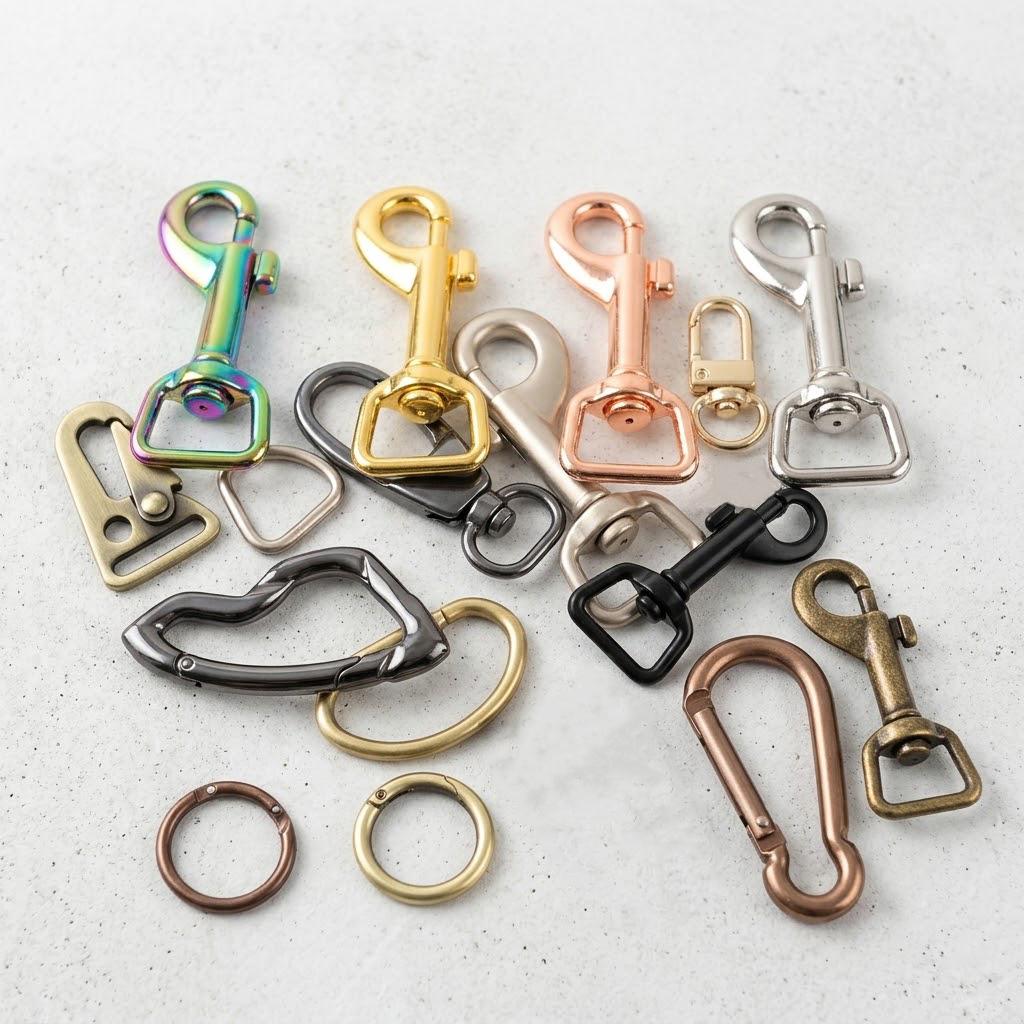
A coating that sails through laboratory wear tests can still fail within weeks if the real environment includes stresses no bench test reproduced. Matching begins with a close look at how the part actually degrades: impact frequency, sliding contact, chemical splash concentration, temperature cycling, and whether damage tends to start at edges, welds, or fastener holes. Those specific details usually reveal more than broad labels like abrasion resistant or chemical resistant.
The metal substrate and the coating should be treated as a single system rather than two separate choices. A very hard coating on a softer base can crack or spall under concentrated load, while a slightly tougher coating may survive simply because it flexes with the metal underneath. Corrosion creep at a scratch, galvanic differences between coating and substrate, and surface preparation profile all affect whether the layer stays bonded when moisture and salts find their way into a damaged area.
Field trials work best when they reproduce the geometry, shutdown cycles, cleaning routines, and maintenance access of the actual equipment. Coated test patches placed where real wear and washdowns occur will expose mismatches much faster than laboratory coupons. The aim is not the hardest or thickest option, but the combination that keeps functioning under the operating rhythm the equipment really sees.
Gate Tension as a Predictor of Field Life
Field life rarely hinges on a single threshold crossing. Gate tension, tracked over repeated switching and temperature cycles, tends to reveal the onset of oxide damage before hard failures appear. In devices that later fail in the field, a slow upward creep in gate leakage often precedes threshold drift by weeks or months, making it a useful early signal when sampled regularly.
The predictive value becomes clearer when gate tension is read in context. A high gate voltage overshoot that lasts only nanoseconds may look benign in a datasheet curve, yet under humid or thermally unstable conditions it can accelerate charge trapping near the gate edge. Devices with tight gate drive loops and well-damped waveforms usually show flatter tension trends and longer service life, while the same part number mounted on a noisy board may degrade along a steeper path.
For practical screening, the trend matters more than any absolute reading. A device whose gate tension drifts slowly but stays within a narrow band can remain serviceable far beyond nominal ratings, whereas one that shows sudden spikes in reverse-bias leakage tends to fail shortly after. Plotting these small changes against operating hours turns gate tension into a leading indicator rather than a post-mortem marker.
Which Load Rating Numbers Actually Matter
A tire's load rating is not one number; it is a small cluster of figures that only makes sense when read together. The load index usually gets the most attention, but it only tells part of the story if you ignore the speed symbol next to it. A 94V and a 94H may carry the same weight at their listed speeds, yet the V-rated tire is built to handle that load at a higher sustained speed. So the number that actually matters first is the combined load index and speed rating, not either figure in isolation.
For trucks, vans, and anything that tows, the axle and gross vehicle weight ratings are where real decisions happen. A tire may have a high enough load index on paper, but if the front or rear axle rating is exceeded, you are running outside the vehicle's design envelope. The manufacturer's door sticker is more useful than the maximum pressure number molded into the tire because it accounts for weight distribution, not just total capacity. In that sense, the load index is a starting point, while the axle rating is the number that keeps you out of trouble.
Ply rating and load range letters still confuse people because they sound like a physical feature but have become mostly symbolic. A load range E tire does not actually contain ten plies anymore; the letter simply points to a standardized inflation and capacity threshold. That threshold matters if you frequently run near maximum load, because the pressure must rise with the weight. Ignoring the inflation table while choosing a higher load range can leave you with a stiff ride and no extra safety margin.
Sampling Large Orders Without Getting Fooled by the Top Layer
Large orders often look straightforward on the surface because the top-level record shows a clean total. But beneath that single line sits a stack of smaller transactions, partial fills, or split shipments that can quietly distort your understanding of what actually happened. If you only skim the summary row, you miss the uneven timing, the manual adjustments, and the odd fee structures that live one level down.
A more reliable approach is to treat every large order as a container rather than a single event. Open it up and compare the child rows against the parent total. Check whether the pieces sum to the headline number, whether any line item was entered days after the rest, or whether a discount was applied only to certain legs of the order. These mismatches rarely show up in the top layer, but they are exactly what cause revenue recognition errors and awkward customer follow-ups.
The practical habit is to sample the children, not just the parents. Pick a few big orders and trace each line back to its source system, looking for breaks in the sequence or values that were edited after posting. When you do this consistently, you stop being impressed by the size of the order and start seeing the structure underneath it, which is where most surprises tend to hide.
Supplier Questions That Reveal More Than a Spec Sheet
A spec sheet shows what a supplier wants you to measure. What reveals more is asking which orders they have refused in the past six months and what made those jobs a poor fit. Their answer often points to the real limits of their equipment, the honesty of their sales team, and whether they see rejection as a normal part of doing good work.
Try a question about the worst batch they shipped in the last year. A bland answer about a minor delay is less useful than a supplier who can describe the exact point where something slipped, what they changed afterward, and how they communicated with the customer. That level of recall shows the problem was treated as something to learn from rather than hide.
It also helps to ask how they handle a sudden 30 percent jump in orders without cutting corners. If they mention specific overtime limits, backup operators, or raw material buffers, the answer carries weight. If they only say they can scale, you have just learned more than any capacity table would tell you.
FAQ
Material choice and gate design usually tell the story. Stainless steel or forged carbon steel with a corrosion-resistant coating handles stress and weather far better than zinc alloy or thin stamped parts. Check for a solid spring mechanism and a gate that seats fully into the nose—those small details prevent most field failures.
Welded rings tend to outperform stamped eyes under heavy or shifting loads because the joint is fused rather than bent. A well-made stamped eye can still work for light-duty use, but for anything that will hold weight or take impact, look for a fully closed, welded attachment point.
Ask for batch test reports or third-party certification. A legitimate load rating comes from destructive testing on actual production samples, not just a number copied from a catalog. If the supplier cannot tell you how the rating was verified, treat it as a rough estimate rather than a safety limit.
Electropolished stainless steel usually wins for salt and moisture exposure because there is no coating to chip. For carbon steel, look for a thick, uniform zinc-nickel plating or a baked-on coating that covers the gate and spring area. Thin zinc plating fades quickly once the surface gets scratched.
Not if the supplier has a real incoming inspection process. Ask how they handle lot-to-lot variation—whether they check dimensions, spring tension, and coating thickness before shipping. A good bulk order should look like one production run, not a mix of leftovers.
A wide-mouth or wire gate with a smooth, rounded thumb catch usually works best. Swivel-eye designs also help keep the hook aligned so you are not fighting the hardware while clipping. If the gate requires pinching a tiny tab, it becomes miserable in cold weather or when hands are wet.
Choose stainless when the hardware lives outside, near saltwater, or in food and medical environments. Coated carbon steel can save money indoors and still last if the coating is high quality, but once the coating wears through, rust follows quickly. For long-term durability in tough conditions, stainless pays for itself.
Sometimes, but brand alone is not a guarantee. Compare the actual specifications, finish, and test data side by side. A lesser-known supplier with verifiable testing and consistent samples can deliver equal or better value, especially if you run a small pilot order before committing to thousands of units.
Conclusion
Most failures in bulk snap hook orders are not caused by a single dramatic overload but by repeated stress at the gate hinge, where a tiny amount of play wears through the coating and starts corrosion long before the hook looks damaged. The practical approach is to match stainless steel or zinc-plated carbon steel to the actual environment, not to the cleanest version of the job site. Coastal salt, chemical residue, and constant moisture demand a different coating than dry indoor storage, and buyers who ignore that distinction often see identical load ratings perform very differently. Gate tension is another underused clue: a firm, consistent snap action across a sample usually points to better assembly and longer field life than a stiff or sloppy gate, regardless of what the catalog claims.
When reviewing large quantities, the top layer of a carton is a weak basis for judgment. Mixed production runs can hide inconsistent barrel forming, thin spots, or poorly seated rivets a few rows down, so sampling from multiple boxes at different depths is the only way to get a true read. The load rating that matters most is the one tied to the way the hook will actually be pulled; side-loading or dynamic shock can invalidate a straight-pull working load limit. It is also worth pressing suppliers on how they handle lot traceability, batch testing, and returned-field samples. Their answers, or hesitation, reveal more about consistency than a polished spec sheet ever will.
Contact Us
Contact Person: Jamie Zeng
Email: [email protected]
Tel/WhatsApp: +86 13728219269
Website: https://www.kmhardware.com